



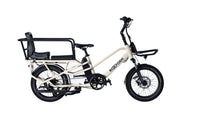
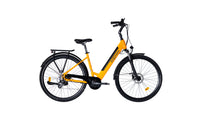
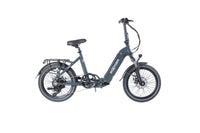

A new e-bike arrives and all the attention goes to the motor, the battery and the price. Then the clocks change, the roads stay wet for a fortnight, and what actually decides whether you ride is duller than any of that: whether the mudguards reach far enough, whether the rack is rated for what you want to put on it, and whether the kickstand holds the bike up once it is loaded. E-bike mudguards, rack fittings and stands are the parts nobody photographs, and the ones riders most often wish they had thought about first.
What e-bike mudguards, rack and kickstand choices actually change
None of these parts makes a bike faster. What they change is how many days a year you use it.
- Mudguards decide whether you arrive in a state you can work in, and how much road grit ends up on your chain and brake pads.
- The rack decides whether the bike can carry a shop, a laptop bag or a child seat, and how much weight sits where.
- The kickstand decides whether loading the bike is a two-person job or a one-handed one.
They also interact. A rack bag sits where your rear light sits. A loaded rack changes what a single-leg stand can hold. Full-length mudguards need clearance that wide tyres may not leave.
Mudguards: coverage, clearance and the rear light problem
The difference between a short clip-on guard and a full-length one is not the material. It is how far down the wheel it reaches.
A short rear guard keeps the worst of the spray off your back. A full-length rear guard, carried down past the chainstays, also keeps it off the drivetrain and off whoever is riding behind you. At the front, the useful measure is how far the guard extends forwards and down: a stub guard will protect the frame while your feet still get soaked.
Two practical constraints:
- Clearance. A guard needs room for the tyre plus mud. Move to a wider or more heavily treaded tyre and a guard that fitted perfectly will often start rubbing.
- Rattle. Guards fail at their stays long before they fail anywhere else. Check the bolts at the end of the first wet month, then at every service.
What mudguards do not do: they do not keep you dry from above, and they do not stop the spray thrown up by cars. For that you need the winter kit that actually works, not a longer guard.
Racks: load limits, and the standard behind the number
Every rack has a maximum load, and it is set by the rack and the bike together, not by the rack alone. A rack rated for 25kg bolted to mounts rated for less is limited by the mounts.
The test standard for bicycle luggage carriers is ISO 11243, Cycles — Luggage carriers for bicycles — Requirements and test methods. The current edition is ISO 11243:2023; the previous British adoption, BS EN ISO 11243:2016, was withdrawn in September 2023 and BSI now points UK users to the ISO edition. It covers carriers mounted above and adjacent to the wheels, whether sold with a complete bike or fitted afterwards.
Two exclusions matter in practice. ISO 11243 does not apply to removable luggage such as handlebar bags or baskets that are not permanently attached, and it does not cover toy carriers for young children, which fall under ISO 8098. A clip-on basket is not tested to the same regime as a bolted rack, however solid it feels in the shop.
We do not publish one rack figure for the whole Roxform range, because it is not the same across it. The number for your bike is in the manual supplied with it. If you cannot find it, send us the frame number and we will confirm it before you load anything on — particularly if a child seat is involved.
On child seats: the Urban Iki TA-KE rear seat we sell at £89.99 is rated for children from 9 months to around 6 years, up to 22kg or 110cm, and mounts to a pannier rack with its own carrier mount. The seat's limit and the rack's limit are separate numbers, and the lower of the two applies. Our guide to carrying children by e-bike covers the rest.
Where the law comes in: do not bury your rear reflector
This is the part riders get wrong most often, and it is the only part of this article that is a legal requirement rather than a preference.
Under the Road Vehicles Lighting Regulations 1989, a pedal cycle used between sunset and sunrise must carry a white front lamp, a red rear lamp, a red rear reflector, and amber or yellow pedal reflectors front and rear on each pedal. Lamps may be steady or flashing. The only exemption is riding between sunrise and sunset.
The detail that catches people out is where the rear reflector has to be. The Regulations require it to be red, fitted at or near the rear, on the centre line or off side of the bike, and plainly visible to the rear. The permitted height is between 250mm and 900mm from the ground, or up to 1500mm where the structure of the bike makes 900mm impracticable. Triangular rear reflectors are not permitted on a cycle.
A rack-top bag, a crate or a child seat can sit directly in front of the reflector and the rear lamp. If it does, the bike is not compliant after dark, and a driver behind you cannot see what the reflector is there to show. The fix is cheap: fit a second rear lamp to the rack or the bag, and check the sight line from behind with the bike loaded as you actually ride it.
Kickstands, and a part-by-part checklist
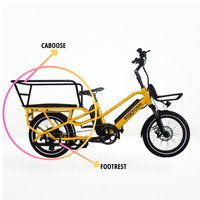
A single-leg stand is lighter and gets out of the way. It holds an unloaded bike on level ground and very little else. Put 15kg on a rear rack and the bike wants to pivot around that single point.
A double-leg centre stand gives a much wider base. It is heavier and it can catch a pedal when you walk the bike backwards, but on a longtail it is not really optional — loading a child onto a bike held up by one leg is not something we would recommend.
Whichever you have, check it holds the bike with your usual load on a cambered kerbside rather than a flat floor, check it retracts clear of the cranks, and have the mounting bolts checked at every service. A stand that folds under load is a dropped bike.
| Part | The detail that matters | Common mistake |
|---|---|---|
| Full-length mudguards | How far down the wheel they reach, front and rear | Assuming any guard protects the drivetrain |
| Clip-on guards | Tyre clearance under load | Fitting them after moving to a wider tyre |
| Bolted rear rack | The lower of the rack limit and the frame mount limit | Reading only the rack's number |
| Clip-on basket | Not covered by ISO 11243 | Loading it like a bolted rack |
| Rack bag or crate | Sight line to the rear lamp and reflector | Blocking both and riding after dark |
| Single-leg stand | Behaviour with a loaded rack on a camber | Using one on a cargo bike |
| Double-leg stand | Clearance from the cranks when retracted | Catching a pedal when reversing the bike |
Quick answers
Do I legally need mudguards on an e-bike in the UK?
No. Lamps and reflectors are the legal requirement after dark; mudguards are a comfort and maintenance choice.
Can a rack bag cover my rear reflector?
Not if you ride after dark. The reflector must be plainly visible to the rear and between 250mm and 900mm from the ground. Add a second lamp to the rack or bag.
How much can I put on my rack?
Whichever is lower: the rack's rated load or the frame mount's. The figure is in your bike's manual, and we will confirm it if you send us the frame number.
Is a clip-on basket as strong as a bolted rack?
It is not tested to the same standard. ISO 11243 excludes baskets and bags that are not permanently attached.
Do I need a double-leg kickstand?
On a longtail or any bike you load with a child or heavy shopping, yes. On an unloaded city bike a single leg is fine.
Getting it right from the start
If you are carrying at both ends, the front cargo basket at £80 bolts to the fixing points already built into the PORTO frame — no drilling, and the mounting plate is included. It fits the PORTO L and the PORTO S only, and it will not fit a STRIDE, VALOR, GRAVION, VENTURIS or PLICO.
If you are still choosing a bike, work out what you need to carry first and let that narrow the list — it is far cheaper than retrofitting. The full range is at our collection of e-bikes and accessories. Or email us the load and the route, and we will tell you which models suit it and which do not.


