



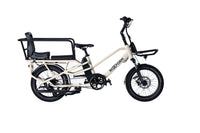
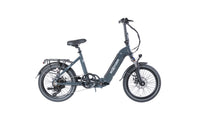

A cargo bike only earns its space in the hallway if it carries what you actually need to carry. Most people who ask us about the Porto range are trying to settle one question: is the compact Porto S enough, or do they need to spend more and live with a longer bike?
Both are 250W electric cargo bikes, both are road legal in the UK, and both ride in much the same way. The real differences are battery size, torque and what you can bolt to the back. Here is how to work out which side of that line you fall on.
What a longtail cargo e-bike in the UK actually replaces
The honest answer is: short, repetitive, loaded journeys. The school run is the obvious one. In the 2025 National Travel Survey, 45% of trips to and from school made by children aged 5 to 10 were made by car, and around 2% were cycled. Most of those car journeys are short and local, and they are exactly what a cargo bike is built to absorb.
What a cargo bike does not replace is the motorway run, the trip to the tip with a wardrobe, or a wet 40-mile round trip with two tired children. We would rather say that plainly than have you find out in February.
Porto S and Porto L side by side
Everything below comes from our own current product pages. Both bikes use a 250W motor limited to 15.5 mph, which is what UK law requires of an electrically assisted pedal cycle.
| Porto S | Porto L | |
|---|---|---|
| Price from | £1,500 | £1,900 |
| Motor | Aikema 36V 250W rear hub | Bafang 36V 250W hub |
| Torque | 45 Nm | 60 Nm |
| Battery | 36V 13Ah (468Wh) | 936Wh dual battery |
| Claimed range | Up to 30 miles | Up to 62 miles |
| Gears | Shimano Altus 7-speed | Shimano Altus 7-speed |
| Brakes | Logan HD hydraulic disc | Logan hydraulic disc |
| Suspension | Suntour cargo fork | Suntour cargo fork |
| Wheels and tyres | 20in, 2.4in wide | 20in, 2.40in wide |
| Charge time | 4 to 6 hours | 4 to 6 hours |
| Colours | Cream, Orange | Orange, Yellow |
The pattern is clear enough. Frames, brakes, gears and tyres are close cousins. The extra money buys battery and torque, and the length to use them.
Range: what "up to 30 miles" and "up to 62 miles" mean
Neither figure is a promise, and no manufacturer's figure ever is. Range depends on rider and cargo weight, gradient, tyre pressure, temperature, wind, how many times you stop and start, and which assistance level you sit in. A loaded cargo bike on a cold, hilly commute will do considerably less than the same bike on a flat towpath in June.
The useful way to read it is proportionally. The Porto L carries roughly twice the battery capacity of the Porto S, so whatever the Porto S gives you on your route, expect the Porto L to give you close to double it. If your daily round trip is six or eight miles and you can charge at home, the Porto S has more than enough headroom. If you are doing a school run and then a commute on the same charge, or you cannot charge at work, the larger battery stops being a luxury. We go into the variables in more detail in our guide to e-bike range for UK riders.
Torque matters more than range on hills
The 60 Nm figure on the Porto L is the one to watch if you live somewhere like Hove, where every route home is uphill. Both bikes are limited to the same 250W continuous rated power, but torque is what you feel pulling away from a junction with a loaded bike. With shopping and a passenger on board, the difference between 45 Nm and 60 Nm is noticeable in first gear on a climb.
Carrying passengers: what the law expects
Rule 68 of the Highway Code is blunt about this. You must not carry a passenger unless your cycle has been built or adapted to carry one. A rear rack is not, on its own, an adaptation for carrying a person.
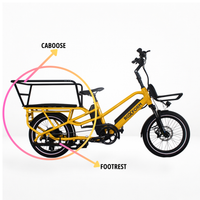
That is why the passenger kit matters more than the bike's length. The Family Pack adds a caboose and footrests designed for the Porto frames, at £175. For a younger child, a properly mounted child seat is the right answer instead. Either way, fit the equipment the bike was designed to take, and do not improvise.
Two further points people get wrong. The minimum age of 14 in the EAPC rules applies to the person riding the bike, not to a passenger being carried. And helmets are not a legal requirement for cyclists in the UK, though Rule 59 of the Highway Code advises wearing one that fits and is securely fastened. We fit them to children as a matter of course.
Carrying things instead of people
If your load is shopping, tools or delivery boxes rather than a child, the calculation changes. The Porto S handles a week's food, a laptop and a set of tools without complaint, and it is the easier of the two to park, turn and store. A front cargo basket at £80 takes the bulky, light items off the rear rack and keeps the weight where it upsets the steering least.
Rule 66 of the Highway Code asks you not to carry anything that affects your balance or could tangle in the wheels or chain. On a cargo bike that translates to three habits: load low, strap everything down, and put the heaviest item closest to the rear axle. Check the maximum total weight in the manual that came with your bike, and if you are not sure, ask us before you load it rather than after.
What you actually pay
The Porto S is £1,500 in either colour. The Porto L starts at £1,900 as a base model without accessories, £1,930 with the cushion seat, £2,075 with the Family Pack, and £2,105 with both. That last figure is the one to hold in your head if you are buying it to carry a child, because that is the version that does the job out of the box.
Both are eligible for Cycle to Work. There has been no single legal cap on the scheme since the government refreshed its employer guidance in June 2019 to make it easier to provide bicycles and equipment worth over £1,000. What you can spend is set by your employer and their scheme provider, and what you save depends on your tax band, so treat any headline percentage as a range rather than a promise and check with your provider. Our Cycle to Work guide covers the mechanics.
So which one
- Buy the Porto S if you are carrying things rather than people, your daily distance is under roughly 15 miles, your terrain is mostly flat, and storage space is tight.
- Buy the Porto L if you are carrying a passenger, you live somewhere hilly, or you need to do more than one loaded trip between charges.
If you are genuinely on the fence, the passenger question decides it. Everything else about the Porto S is adequate for most urban life; carrying a person is the thing it is least suited to.
Quick answers
Are these bikes legal on UK roads and cycle paths?
Yes. Both have a 250W continuous rated motor, assistance that cuts out at 15.5 mph and working pedals, which is what the EAPC rules require. No licence, tax or insurance is needed, and the rider must be at least 14.
Can I carry my child on the Porto S?
Only with equipment built for the job, such as the Family Pack or a correctly fitted child seat. The Highway Code does not allow carrying a passenger on a cycle that has not been built or adapted for it.
Will the Porto L really do 62 miles?
Under favourable conditions with a light load and low assistance, it can approach it. On a loaded winter school run in a hilly town, plan on considerably less and charge more often.
Do I need a bigger motor for hills?
You cannot legally have one on an EAPC. The 250W limit is fixed, so the useful comparison is torque: 60 Nm on the Porto L against 45 Nm on the Porto S.
Can I buy either through Cycle to Work?
Yes. The limit is set by your employer and their scheme provider, not by a national cap.
Where to go next
Full specifications, colours and accessory options are on the Porto S and Porto L pages. If you would rather try before deciding, a loaded test ride on a hill tells you more in ten minutes than any spec sheet, and we will arrange one.


