




Almost every conversation we have with someone before they buy arrives at the same question: how far will it actually go? The claimed number on a product page — ours included — is a best case, not a promise. Real e-bike range depends far more on your weight, your route and your right hand on the assistance button than on the badge printed on the battery.
This guide explains where those claimed figures come from, what genuinely drains a battery on British roads, and how to work out a planning number you can trust for your own journeys.
What e-bike range figures actually measure
Less than you would hope. The standard that governs electrically assisted pedal cycles in this country, BS EN 15194, sets safety and performance requirements for the design, assembly and testing of the bike, its electrical circuits, its power management system and its charger. It does not require manufacturers to publish a range figure produced by one common, comparable test.
So when any brand quotes "up to 60 miles", that figure almost always comes from the manufacturer's own testing under favourable conditions: a light rider, the lowest assistance setting, flat ground, mild weather, correct tyre pressures and very few stops. Not one of those conditions describes a loaded Tuesday commute across Brighton and Hove in February.
We quote "up to" figures too, because customers compare them and it would be odd not to. What we will not do is pretend they are what you will see.
Start with watt-hours, not miles
The only number that lets you compare two e-bikes honestly is battery capacity in watt-hours (Wh). It is volts multiplied by amp-hours. A 36V 12.8Ah battery holds roughly 461Wh. Miles are an interpretation of that figure; watt-hours are the figure itself.
Divide the battery capacity by the claimed range and you can see what each manufacturer quietly assumed about consumption. Here are our own bikes, using the specifications published on their product pages:
| Model | Battery | Claimed range | Implied consumption |
|---|---|---|---|
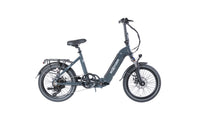
| STRIDE S | 36V 12.8Ah (about 461Wh) | Up to 40 miles | About 12Wh per mile |
| PLICO | 468Wh | 40 to 60 miles | About 8 to 12Wh per mile |
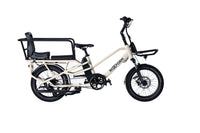
| PORTO L | 936Wh dual battery | Up to 62 miles | About 15Wh per mile |
Those consumption figures are optimistic, and deliberately so — they are what the bike will do on a good day. For planning a journey you actually have to complete, we would work on 15 to 25Wh per mile instead. On that basis a STRIDE S is a comfortable 20 to 30 mile bike and a PORTO L is a comfortable 37 to 60 mile bike, loaded, in normal British conditions.
What really drains the battery
Range is not one variable. It is six or seven, and they compound.
| Factor | Effect on range | What to do about it |
|---|---|---|
| Total weight | Large. The motor lifts you, the bike, the shopping and any passengers up every gradient | Carry what you need, not what fits |
| Gradient | Large. Climbing is where watt-hours disappear fastest | Change down early and let the gears do some of the work |
| Assistance level | Large. The top setting can halve what the lowest achieves | Ride in the lowest level that still feels good |
| Speed and headwind | Significant. Air resistance climbs steeply as speed rises | Sitting at 12 mph rather than 15.5 mph buys real distance |
| Stop-start riding | Significant. Every set of lights means accelerating the whole load again | Anticipate, coast, avoid the busiest junctions |
| Tyre pressure | Moderate. Soft tyres cost energy on every revolution | Check pressures weekly against the sidewall figure |
| Cold | Moderate. Lithium-ion cells deliver less usable capacity at low temperatures | Store and charge the battery indoors, fit it just before you leave |
One point that surprises people: by law, motor assistance on an electrically assisted pedal cycle must cut out at 15.5 mph. Above that you are pedalling the bike yourself, which is perfectly legal and often pleasant, but it means the last stretch of a fast descent costs you nothing at all. We have written the rest of the legal detail up in our guide to UK e-bike law in 2026.
How far do you actually need to go?
It is worth checking the question before agonising over the answer. The Department for Transport's National Travel Survey found that people in England made an average of 922 trips and travelled 6,082 miles in 2024 — roughly 6.6 miles per trip across every mode, car journeys included. The same survey recorded an average of 15 cycling trips and 53 miles cycled per person over the year.
In other words, the overwhelming majority of journeys people actually make are far shorter than any competent e-bike battery. If your commute is five miles each way, a 461Wh battery is not a compromise; it is several days of riding between charges.
What a charge costs
Charging is cheap enough that it rarely changes a buying decision, but people ask, so here is the arithmetic. Under the Ofgem price cap, the average electricity unit rate for direct debit customers in England, Scotland and Wales is 26.11p per kWh for 1 July to 30 September 2026, rising to 26.32p per kWh from 1 October 2026.
- A 461Wh battery holds about 0.46kWh, so a full charge costs roughly 12p of electricity.
- A 936Wh battery holds about 0.94kWh, so a full charge costs roughly 25p.
Add a few pence to each for charging losses and you are still nowhere near the cost of a bus fare. Always use the charger supplied with the bike — the reasons why are set out in our e-bike battery safety guide.
Getting more out of the battery you have
- Set tyres to the pressure printed on the sidewall and check them weekly.
- Use the gears properly. An e-bike still has a drivetrain, and spinning a sensible cadence costs the motor less.
- Start hills in a low gear rather than asking the motor to rescue a high one.
- Drop an assistance level on the flat and save the top setting for gradients and pulling away.
- In winter, keep the battery indoors between rides and fit it shortly before you set off.
- For an unfamiliar long ride, plan a café stop where you can put an hour of charge in.
Quick answers
Does the claimed range mean I will get that far?
No. Treat it as a best case from favourable testing conditions. Plan on roughly 60 to 70 per cent of the claimed figure for ordinary loaded riding.
Is a bigger battery always better?
Not always. A bigger battery adds weight and cost, and if your longest regular ride is eight miles you will simply be carrying capacity you never use. Match the battery to your actual week.
Does the motor stop working at 15.5 mph?
The assistance does. The bike does not — you keep pedalling as you would on any bicycle. This is a legal requirement for electrically assisted pedal cycles in the UK.
How much does a full charge cost?
Between about 12p and 25p of electricity for the batteries we fit, at the current price cap unit rate.
Will range drop as the battery ages?
Yes, gradually. Lithium-ion capacity declines with charge cycles and with time, which is why a used bike's claimed range should always be treated with suspicion.
Choosing a Roxform on range
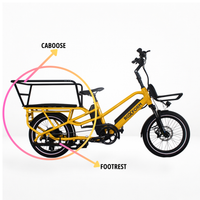
If your riding is city commuting and errands under about 15 miles a day, the STRIDE S and its 461Wh battery has more capacity than you will regularly need. If you are carrying children, cargo or doing longer mixed days, the PORTO L and its 936Wh dual battery is the one that removes range from the list of things you think about. You can see the full line-up in our electric bikes collection, and if you are unsure, tell us your commute in miles and where the hills are — that is a far more useful conversation than comparing headline numbers.
Sources
- GOV.UK — Electric bikes: licensing, tax and insurance
- BSI — BS EN 15194:2017, Cycles: electrically power assisted cycles
- Ofgem — Energy price cap unit rates and standing charges
- Department for Transport — National Travel Survey 2024 factsheet
- Department for Transport — National Travel Survey 2024: active travel


