




Most people who buy a folding e-bike in the UK buy it for one reason: half their journey is a train. The good news is that a folding e-bike on a train is one of the few areas of e-bike travel where the rules are genuinely simple and genuinely generous. The awkward news is that the thing you are folding still weighs over twenty kilos, and no rulebook fixes that.
Here is what the operators actually allow, and where our own Roxform PLICO fits and does not fit.
The basic rule: folded bikes travel as luggage
National Rail's position is short. "You're welcome to bring your folding bike on all trains, at no extra cost." There is no reservation, no booking fee and no peak-hour ban, provided the bike is folded and stowed as luggage.
That last clause is the whole deal. A folded bike is not treated as a bicycle at all — it is treated as a suitcase. Unfold it on the platform and you lose those freedoms instantly.
Southern and Thameslink put it in almost identical words: if you have "a fully folding bike, a fully folding e-bike, or a folding manual scooter, you can bring these on board at any time." Southern defines fully folding as a bike with small wheels that folds in more than one place.
Compare that with a full-size bike on the same network. Southern bars non-folding bikes from trains arriving at London, Brighton or Kensington Olympia between 07:00 and 10:00 on weekdays, and from trains leaving those places between 16:00 and 19:00. If you live in Hove and work in London, that is precisely the window you need to travel in.
Taking a folding e-bike on a train: what each operator asks for
| Operator | Folded bike or folded e-bike | The condition attached |
|---|---|---|
| National Rail (network-wide guidance) | All trains, any time, free | Must be stowed as luggage |
| Southern and Thameslink | On board at any time | Must be "fully folding" — small wheels, folds in more than one place |
| Southeastern | Any train, any time, free | Wheels 20 inches or smaller; folded before you reach the platform and kept folded on board |
| Great Western Railway | Any train, any time, no reservation | Maximum 20-inch wheel; the e-bike must be road legal |
| London Overground | All times | One folded bike per vestibule area at peak times |
| Tube, DLR, Elizabeth line | Anywhere, any time | Must be folded; non-folding e-bikes are banned outright |
Two patterns run through all of it. Every operator wants the bike folded before you are on the platform, not as the doors open. And several cap wheel size at 20 inches, which is why serious folding bikes cluster around that number.
London is the case that really matters
Since 31 March 2025, Transport for London has banned all non-folding e-bikes from most of its network. TfL's own reporting describes it plainly: it "banned all non-folding e-bikes from most of our services including London Underground, London Overground, DLR, Elizabeth line and the IFS Cloud Cable Car from 31 March 2025 to ensure the safety of customers." The move followed London Fire Brigade advice, with cycles adapted using conversion kits the particular concern.
Folded cycles were left alone. TfL's current guidance still reads: "You can take folded cycles anywhere, at any time on all our transport services."
So in London the folding mechanism is not a convenience. It is the difference between being allowed on the Underground and not being allowed on it at all. E-scooters remain banned on TfL services whether folded or not.
Your e-bike still has to be road legal
Operators are not running a separate certification scheme. They rely on the existing EAPC rules, and GWR spells the test out: a road-legal e-bike has "a motor that generates a maximum continuous rated power output of 250 watts and does not provide electrical assistance when travelling at more than 15.5 mph."
That matches the law. Under the government's EAPC rules an electric bike must have pedals that can be used to propel it, a continuous rated power output of no more than 250 watts, and a motor that cuts assistance above 15.5 mph. You must be 14 or over, and no licence, tax or insurance is required. Our guide to UK e-bike law in 2026 covers it in full.
The consequence is blunt: a derestricted bike, or one fitted with a conversion kit of unknown provenance, is not a legal EAPC. On GWR, electrically modified e-bikes and hire bikes such as Dott and Lime are explicitly refused.
Charging and batteries: the rule nobody reads
You cannot charge on the train. Southeastern states it directly: "For everyone's safety, charging e-bikes is not permitted on the train." GWR goes further and bans charging at stations as well as on board, along with visibly damaged batteries.
Plan around it rather than resenting it: build the full round trip into your range instead of hoping to top up on the 17:42. Our guide to e-bike battery safety covers charging habits, what a damaged battery looks like, and why the supplied charger is the only one you should use.
What a folding e-bike will not do
We would rather say this than have you find out at Clapham Junction.
- It is not light. The PLICO weighs 19.3 kg without the battery and 22.48 kg with it. Folded, that is a manageable thing to wheel and lift onto a rack; it is not a manageable thing to carry up two flights of stairs at a station with no lift.
- Folding takes a moment. Budget a minute at each end, and do it before the platform, not on it.
- Small wheels ride differently. 20-inch wheels are more affected by potholes and drain covers than 28-inch ones. On Brighton and Hove's road surfaces you notice.
- Space is still discretionary. Staff can ask you to move a folded bike, and London Overground limits folded bikes to one per vestibule at peak times.
Where the PLICO fits
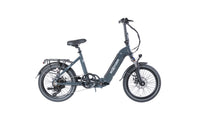
The PLICO is a 20-inch folding e-bike at £1,450. It runs an Ananda 36V 250W hub motor with a 468Wh battery, a Shimano Altus 7-speed drivetrain and mechanical disc brakes. Charging takes 4 to 6 hours from the supplied charger.
The quoted range is 40 to 60 miles. Treat that as a window rather than a promise: a flat, warm, low-assist ride sits near the top, and a cold, hilly, loaded commute in maximum assist sits well below the bottom. For a train-plus-ride commute the real question is whether it covers two short legs for several days between charges, and for most riders it does comfortably.
The 20-inch wheel matters more than it looks. It is exactly the size Southeastern and GWR cap folding bikes at, so the PLICO meets the strictest wheel limit we found rather than sitting just outside it.
If your journey has no train in it, a folding bike is the wrong tool and you are paying a comfort penalty for nothing. The Roxform STRIDE S is the better commuter then, and the rest of the range sits in our electric bikes collection.
Quick answers
Do I need to book a space for a folding e-bike on a train?
No. Folded bikes travel as luggage on all National Rail services at no extra cost and without a reservation. Non-folding bikes are the ones that need booking or face peak restrictions.
Can I take a folding e-bike on the London Underground?
Yes, as long as it is folded. TfL allows folded cycles anywhere on its network at any time, but has banned all non-folding e-bikes from most services since 31 March 2025.
Is there a size limit for folding bikes on trains?
Several operators cap it at a 20-inch wheel, including Southeastern and Great Western Railway. Southern and Thameslink instead require the bike to be "fully folding" — small wheels and folding in more than one place.
Can I charge my e-bike on the train?
No. Southeastern prohibits charging on board, and GWR prohibits it at stations as well. Plan your range around the full round trip.
Does a folding e-bike need insurance or a licence?
No. An EAPC does not need to be registered, taxed or insured, and no licence is required. You must be 14 or over to ride one.
If a train is half your commute
On a rail commute the folding mechanism turns a bike from cargo into luggage, and in London it is what gets you through the barriers at all. If that describes your week, the PLICO is the bike in our range built for it. Try folding one before you buy; thirty seconds tells you whether you can live with the weight.
Sources
- National Rail — Train travel with bicycles
- Transport for London — Cycles on public transport
- Transport for London — Commissioner's report, 11 June 2025
- GOV.UK — Electric bikes: licensing, tax and insurance
- Great Western Railway — Cycle and scooter policy
- Southern — Taking a bike on the train
- Southeastern — Cycles on trains


