



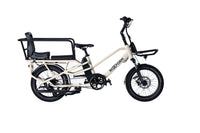
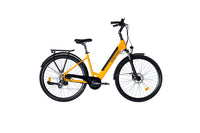
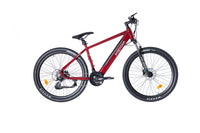
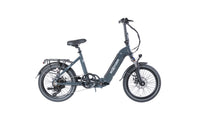

Most of the confusion about electric bikes in the UK comes from a handful of numbers that get quoted wrongly, and from bikes being sold here that were never legal to ride on a public road in the first place. This is the current position, in plain English, with the primary sources so you can check it yourself.
The short version
If a bike meets all of the conditions below, the law treats it as a normal pedal cycle. It is called an EAPC — an electrically assisted pedal cycle.
| Requirement | The rule |
|---|---|
| Motor power | Continuous rated power of no more than 250W |
| Assisted speed | The motor must stop propelling the bike above 15.5 mph (25 km/h) |
| Pedals | Must have working pedals that can propel the bike |
| Rider age | 14 or over |
| Markings | Power output and either the manufacturer or the battery voltage and maximum speed must be shown on the bike |
Meet all five and you need no licence, no registration, no vehicle tax and no insurance. Miss any of them and the bike is legally a motorcycle or a moped, which means type approval, registration, tax, insurance and a licence — none of which a normal e-bike can realistically get.
What you don't need
- A licence. None required for an EAPC.
- Insurance. Not legally required. Plenty of riders take out theft and accident cover anyway, which is a separate decision.
- Vehicle tax or an MOT. Neither applies.
- A helmet. Not a legal requirement in the UK for any adult cyclist. We'd still recommend one, and it is the single cheapest bit of kit you'll buy.
The 250W number is more forgiving than it sounds
"Continuous rated power" is not the same as peak power. It is the power a motor can sustain indefinitely without overheating, measured to a defined standard. A compliant 250W motor can draw considerably more than 250W for short bursts — which is exactly what happens when you pull away from a junction or start up a hill.
This is why a legal 250W e-bike climbs far better than the number suggests, and why "you need 500W for British hills" is a sales line rather than an engineering fact.
Throttles: the bit that confuses everyone
A throttle that moves the bike without pedalling is where most imported bikes fall foul of the rules. The position is:
- A walk-assist function that moves the bike at up to 4 mph while you push it is fine.
- A twist-and-go throttle that propels the bike up to 15.5 mph without pedalling requires vehicle type approval. Without that approval, the bike is not an EAPC.
- Pedal assist that cuts out at 15.5 mph is what nearly every compliant UK e-bike uses, including every bike we sell.
What changed in 2025 — and what didn't
The Department for Transport consulted on two significant changes: raising the maximum continuous rated power from 250W to 500W, and allowing throttle assistance up to 15.5 mph without type approval.
In January 2025 the government confirmed it would not take either proposal forward. The stated reasons were a lack of evidence to substantiate the claimed benefits, and opposition from the majority of the main stakeholder organisations that responded — local authorities, police forces, safety bodies and retailers. Of 2,121 responses, opinion on the power limit was close to evenly split, but the organisations closest to the issue were against it.
So the practical position for 2026 is unchanged: 250W and 15.5 mph. Anyone selling you a 500W or 750W bike as "UK legal" is wrong, whatever the listing says.
Northern Ireland
Northern Ireland used to treat e-bikes as motor vehicles requiring a licence, registration and insurance. That changed in 2020, and the rules there now broadly match the rest of the UK.
Where you can ride
An EAPC can go anywhere a pedal cycle can go: roads, cycle lanes, and shared-use paths where cycling is permitted. It cannot be ridden on a pavement, and it has no automatic right of access to footpaths or bridleways that exclude cycles. Local rules on towpaths and parks vary, so check the signage.
E-bikes and e-scooters are frequently lumped together in news coverage. They are not the same in law: privately owned e-scooters remain illegal to use on public roads and pavements in Great Britain, while EAPCs are entirely legal.
How to spot a bike that isn't legal
Warning signs on a listing or in a shop:
- Motor power quoted as 500W, 750W or 1000W, with "peak" quietly attached
- A top assisted speed above 15.5 mph — often written as 20 mph or 28 mph
- A twist throttle described as "for off-road use only" on a bike that plainly has lights, mudguards and a rack
- A "sport mode", "unlock" or "derestrict" setting mentioned in the manual or in reviews
- No markings on the frame or motor showing power and speed
Riding a derestricted bike on a public road makes you an uninsured, unlicensed motorcyclist. Insurers decline claims on that basis, and it is the sort of detail that surfaces after an accident rather than before one.
Quick answers
Do I need a licence to ride an e-bike in the UK? No, provided the bike meets the EAPC rules — 250W, assistance cutting out at 15.5 mph, working pedals, rider aged 14 or over.
Do I need insurance for an e-bike? Not by law. Theft and third-party cover is optional and worth pricing up if the bike is expensive.
Can an e-bike go faster than 15.5 mph? Yes — under your own legs, on a descent, or with a tailwind. The rule limits the motor, not the bike.
Is 250W enough for hills? For almost every UK road, yes. Continuous rated power is a sustained figure, not a ceiling on what the motor delivers in short bursts.
What age can you ride an e-bike? 14 and over. There is no upper limit.
Where Roxform sits
Every bike we build for the UK market is a 250W, 15.5 mph pedal-assist EAPC. No throttles, no unlock modes, no "off-road only" get-out. It means our bikes are legal on any road or cycle lane in the country, and that the person who buys one is not quietly taking on a risk they didn't know about.
If you're choosing your first e-bike, our full range starts with the Stride S at £999. If you'd rather ask a person, we're in Hove and we answer our emails.


