




Somewhere on most British commutes there is a hill that decides everything. If you are wondering what a 250W e-bike can do on hills like that, the honest answer is that it will usually get you up — and that the reasons it does, or occasionally does not, have very little to do with the number 250.
What the 250W limit actually is
In Great Britain an electrically assisted pedal cycle (EAPC) must have, in the government's words, a "continuous rated power output of no more than 250 watts", and it "must not be able to propel the bike when it's travelling at more than 15.5 miles per hour". It must have pedals that can propel it. You can ride one from the age of 14, and it does not need to be registered, taxed or insured.
Two things follow from the exact wording. The limit is on continuous rated power — a rating for sustained output, not a description of how hard the bike feels under your hands. And because the cut-off is a speed limit, not a power limit, it barely matters on a climb: almost nobody is doing 15.5 mph up a steep hill anyway. On gradients, an e-bike is giving you everything it has.
The limit is also settled for now. In January 2025 the Department for Transport published the outcome of its consultation on raising the continuous rated power limit to 500W and allowing twist-and-go assistance up to 15.5 mph without type approval, and confirmed it would "not take forward the proposals that were consulted upon". Anything sold legally as an e-bike in the UK is a 250W bike.
Watts get the headline, torque does the climbing
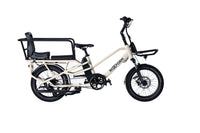
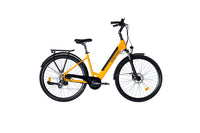
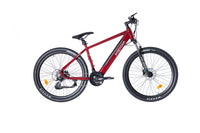
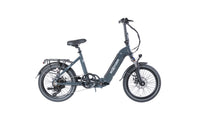
Power tells you how fast work gets done. Torque tells you how hard the motor pushes at low speed — which is exactly the situation you are in halfway up a climb. Every bike in our range is a 250W bike, and they are not remotely the same on a hill:
| Model | Motor | Torque | Weight | Price from |
|---|---|---|---|---|
| Roxform GRAVION | 36V, 250W rear hub | 45 Nm | 21 kg | £999 |
| Roxform STRIDE S | 36V, 250W rear hub | 45 Nm | 21.9 kg (excl. battery) | £1,250 |
| Roxform STRIDE S PLUS | Bafang 250W rear hub | 50 Nm | 19 kg (excl. battery) | £1,450 |
| Roxform VENTURIS | M400, 36V, 250W | 80 Nm | 24 kg | £1,650 |
| Roxform PORTO L | Bafang 36V, 250W | 60 Nm | 27 kg (excl. battery) | £1,900 |
All five are legal EAPCs. The spread between 45 Nm and 80 Nm is the difference between a bike that wants you to change down and pedal, and one that shrugs at a steep start from a standstill. If you want the longer explanation of why motor position matters as much as torque, we wrote that up separately in hub motor or mid-drive.
What a 250W e-bike can climb on a British hill
Climbing is one of the few things in cycling that is genuinely predictable, because it is mostly just lifting weight. The table below is our own calculation for a total system weight of 105 kg — roughly an 80 kg rider, a 21 kg bike and a few kilos of bag — on dry tarmac in still air, with normal rolling resistance for a city tyre.
| Gradient | Power needed to hold 6 mph | Speed at 400W combined |
|---|---|---|
| 3% | 117 W | 15.4 mph (assistance has already cut off) |
| 5% | 175 W | 12.2 mph |
| 8% | 262 W | 8.9 mph |
| 10% (1 in 10) | 319 W | 7.4 mph |
| 12% | 376 W | 6.4 mph |
| 15% | 461 W | 5.2 mph |
| 20% (1 in 5) | 600 W | 4.0 mph |
The "400W combined" column is the point. A 250W motor working hard plus a moderately fit rider contributing 100 to 200 watts gives you somewhere around 350 to 450 watts at the back wheel. At that figure, a 10% climb goes by at roughly 6 to 8 mph and a 20% wall becomes a slow, deliberate 4 mph grind that you will finish, but will not enjoy.
Compare that with the same rider unassisted: on 150 watts of their own, a 10% gradient drops to about 3 mph, which is walking pace. Roughly tripling your sustained power on the steep bits is the whole argument for an e-bike in hilly country.
How steep is the hill in front of you, really?
People routinely overestimate gradients. Road warning signs in the UK show the figure as a percentage, and the DfT's own guide gives the conversions: 10% is equivalent to 1 in 10, and 20% is equivalent to 1 in 5. If a hill is signed at all, it is steep by British standards.
Most of what feels like a brutal commuting climb sits between 4% and 10%, sustained for a few hundred metres to a mile or two. That is squarely inside what a 250W bike handles well. Signed 20% ramps are usually short, and short is the operative word: a brief steep pitch asks far less of a motor than ten minutes of grinding.
What changes the answer more than the motor does
- Total weight. Every extra 10 kg costs you roughly another 30 watts at 10%. A loaded cargo bike with two children aboard is a different vehicle from a bare commuter.
- Gearing. A hub motor helps most when it is spinning. If your lowest gear forces you down to 40 rpm, you will stall long before the motor does. Change down early, keep the cadence up.
- Tyre pressure. Soft tyres are the cheapest way to make a hill harder. Check them weekly.
- Battery state of charge. A near-empty battery sags under load, so the same climb feels harder at the end of a long ride.
- Heat. Long, slow climbs are the hardest thing you can ask of a rear hub motor: ten minutes at 4 mph means a lot of heat and very little airflow.
- Hills eat range. A hilly route cuts real-world range against a flat one, which is why we quote range as a band — see our guide to e-bike range.
Where a 250W bike genuinely struggles
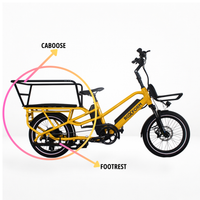
We would rather say this plainly than let you find it out on a Tuesday morning. A legal e-bike is not good at sustained gradients above about 15% when it is heavily loaded and moving slowly. A fully laden longtail cargo bike on a long 1-in-6 will get up, but at walking pace and with the rider working properly.
Restarting mid-climb is awkward on any bike: no momentum, no wheel speed for the motor to work with, and you need a low gear already selected. Change down before the steep section, not during it.
And the thing we will not help with: derestricting. Removing the 15.5 mph cut-off or fitting an unrestricted throttle takes the bike outside EAPC rules and changes its legal status on the road. It also does nothing for climbing, because the cut-off was never what was limiting you.
Quick answers
Can a 250W e-bike climb a 20% hill?
Yes, for a short ramp, at roughly 4 mph with the rider pedalling properly. A sustained 20% climb with a heavy load is where it stops being pleasant.
Is 250W enough for a genuinely hilly commute?
For the great majority of British commutes, yes. The gradients that matter most sit between 4% and 10%, and a 250W bike takes those at roughly 7 to 13 mph.
Does a bigger battery make a bike climb better?
Not directly. Capacity determines how far you can go, not how hard the motor pushes. Torque and gearing determine the climbing.
Why does my bike feel weaker near the top of a long climb?
Usually a combination of the battery sagging under sustained load and the motor warming up. Both recover once you crest and the load drops.
Is a higher torque figure always better?
No. Higher torque draws more current, so an 80 Nm bike ridden hard on hills will use its battery faster than a 45 Nm bike ridden gently. Choose for your terrain, not for the biggest number.
Choosing a Roxform for hills
If your route is rolling rather than mountainous, the Stride S Plus at £1,450 gives you 50 Nm, hydraulic disc brakes and a quoted 60 to 80 mile range — plenty for a hilly commute with charging at one end. If the hills come with rough surfaces, the Gravion at £999 adds front suspension and a choice of 27.5in or 29in wheels, with the same 45 Nm as our city bikes. And if you live somewhere that genuinely goes uphill for a living, the Venturis at £1,650 brings 80 Nm — the highest torque figure in our range.
All of them are 250W, all of them are road legal, and all of them are in our electric bikes collection. If you are unsure which suits your particular hill, tell us the route and we will give you a straight answer.


