



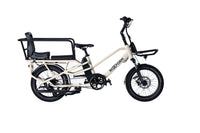
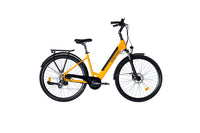
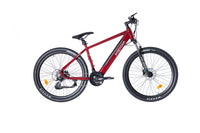
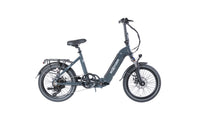

Nobody sells you an e-bike and then explains the insurance position, so it is worth saying plainly: in the UK you are not legally required to insure an e-bike, and e-bike insurance is entirely optional. Whether it is worth buying is a different question, and it depends on what your bike cost and where it sleeps.
The legal position: no insurance required
If your bike is an electrically assisted pedal cycle (EAPC), the government's position is unambiguous: "You do not need a licence to ride an EAPC and it does not need to be registered, taxed or insured." You can ride one from the age of 14, on cycle paths and anywhere else pedal cycles are allowed, though not on pavements.
An EAPC is a bike with a continuous rated power output of no more than 250 watts, fitted with pedals that can propel it, whose motor stops assisting at 15.5 mph. Every bike we sell meets that definition. We went through the rules in more detail in our guide to UK e-bike law.
So there is no equivalent of car insurance for cyclists. No certificate to produce, no continuous insurance enforcement, nothing to renew.
When insurance genuinely is required by law
The exception matters, and it is the reason to be careful about what you buy. If an electric bike does not meet the EAPC rules — a bigger motor, assistance beyond 15.5 mph, no working pedals — it stops being a bicycle in law and is classed as a motorcycle or moped. GOV.UK sets out what follows: it must be "registered and taxed", you need "a valid driving licence to ride one", you must "wear a motorcycle helmet that meets British safety standards", and you must "insure your vehicle".
That is not a technicality. It also means the bike is no longer allowed on cycle paths, and riding it uninsured on a road is a motoring offence rather than a cycling one. If a listing advertises 750W, 1000W or a 20 mph top speed on throttle alone, this is the position you are buying into.
For completeness, the confusion often comes from e-scooters. Privately owned e-scooters cannot legally be used on public land at all, and on the rental trials "the rental scheme operator will provide third-party motor insurance". Neither situation applies to a legal e-bike.
What optional e-bike insurance actually covers
Since nothing is compulsory, the decision is a value judgement. Cover is generally sold to deal with four different risks, and it is worth knowing which of them you actually care about:
- Theft. Usually the reason people buy. This is where policy conditions bite hardest.
- Accidental damage. A frame, wheel or motor damaged in a crash or a fall from a car rack.
- Third-party liability. If you injure someone or damage property. Not legally required, but the reason many riders hold cover at all — it is the one risk where the sum involved could be far larger than the bike.
- Personal accident and recovery. Cover for injury, or getting you and the bike home after a breakdown.
A £1,250 city bike and a £1,900 cargo bike are different propositions. So is a bike that lives in a locked garage versus one chained to railings outside a flat.
Contents insurance or a standalone policy?
Most people's first question is whether their home insurance already covers it. Sometimes it does, often with limits that matter. Rather than guess, read the policy wording and check these specific points — the answers decide whether you need anything extra.
| What to check | Why it matters |
|---|---|
| The single-item limit | Contents policies often cap the value of any one item. An e-bike can sit above that cap even when total contents cover looks generous. |
| Whether cover extends away from home | Theft from a bike rack in town is a different peril from theft from your hallway. Cover away from the home is frequently an add-on. |
| Named lock requirements | Some policies specify a minimum lock standard, or that the frame must be secured to an immovable object. Fail the condition and the claim can fail. |
| Where the bike is stored overnight | Shed, garage, communal hallway and street can all be treated differently, and some storage is excluded outright. |
| New-for-old or depreciated settlement | Decides whether a claim buys you the same bike again or a fraction of it. |
| The excess | On a moderately priced bike a high excess can make the cover close to pointless. |
We are a bike shop, not an insurance broker, so we will not recommend a provider. But we see the consequences of the lock condition often enough to say it is the clause worth reading twice.
The conditions that cost people their claims
Two patterns account for most of the disappointment. The first is a lock that does not meet the standard the policy names — buying cover for a £1,250 bike and securing it with a cable lock is a mismatch you will only discover afterwards. The second is a proof problem: no receipt, no frame number, no photographs.
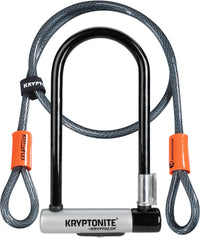
Both are fixable in an afternoon. Photograph the bike, write down the frame number, keep the purchase invoice somewhere that is not the bike, and buy a lock at the rating your policy asks for. Our guide to locks and Sold Secure ratings explains what the ratings mean; the practical step is to match the rating your policy names. The New York Long Shackle U-Lock at £129 is rated Sold Secure Diamond, and at home a Stronghold ground anchor at £89.99 gives you something immovable to lock to.
What about Cycle to Work?
A Cycle to Work bike is typically owned by the scheme provider or your employer during the hire period, which changes who is responsible for insuring it. Some schemes include or offer cover, some require you to arrange it, and the terms vary by provider. Check the hire agreement before assuming either way, and ask your employer's scheme provider directly rather than relying on general advice — including ours.
Quick answers
Is e-bike insurance a legal requirement in the UK?
No. An EAPC does not need to be registered, taxed or insured, and no licence is required to ride one.
Do I need third-party liability cover to ride on the road?
Not legally. Many riders choose to hold it anyway, because it covers the one risk that can cost more than the bike.
Does my home insurance already cover my e-bike?
Possibly, but check the single-item limit, whether cover applies away from home, and any lock or storage conditions before you rely on it.
What if I buy an e-bike that is not road legal?
Then it is treated as a motorcycle or moped: registration, tax, a driving licence, a motorcycle helmet and insurance all become legal requirements, and cycle paths are off limits.
Does a better lock reduce the premium?
It varies by insurer, but a lock that meets the policy's named standard is often a condition of cover rather than a discount. Read the wording.
Buy a bike that keeps the question simple
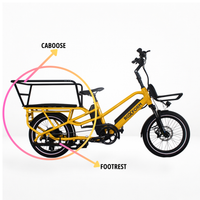
The simplest way to avoid the legal side of this entirely is to buy a bike that is an EAPC to begin with. Everything in our electric bikes collection is 250W with assistance limited to 15.5 mph, so no registration, tax, licence or insurance is required to ride it — including the Stride S at £1,250, our usual starting point for a city commute.
Insurance after that is your call. If you tell us what your bike cost and where it is kept, we will give you an honest view on whether it is worth it.


