



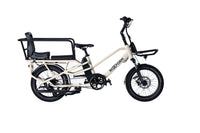
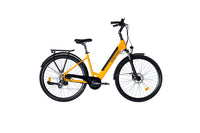
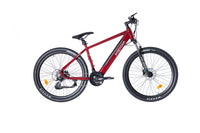
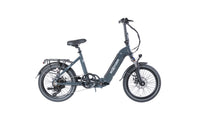
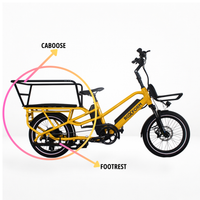

Two e-bikes, similar money, same legal power limit — and one has its motor in the back wheel while the other has it down between the pedals. If you are choosing a commuter bike, hub motor vs mid-drive is usually the first real decision you have to make, and most of the advice written about it assumes American hills or German prices. Here is what the difference actually means on a wet Tuesday morning in Sussex, and where it makes no difference at all.
Hub motor vs mid-drive: what actually differs
A hub motor sits inside the wheel — on our bikes, always the rear wheel — and turns that wheel directly. It has no mechanical connection to your chain, your cassette or your gears. Pedal, and the motor adds its own effort alongside yours.
A mid-drive motor sits at the bottom bracket, between the cranks, and drives the chainring. Its power goes through exactly the same chain and gears that your legs do. When you change gear, you change the motor's gearing too.
That one structural difference explains nearly everything else: how each behaves on a climb, what wears out, how the bike feels when the motor is off, and what a puncture costs you in time.
Both are limited to the same numbers in the UK
This is the part people get wrong. A mid-drive is not legally more powerful than a hub motor. To be an electrically assisted pedal cycle (EAPC) in Great Britain, the bike must have a continuous rated power output of no more than 250 watts, and the motor "must not be able to propel the bike when it's travelling at more than 15.5 miles per hour". It must have pedals that can be used to propel it, and you must be 14 or over to ride one. No licence, and the bike does not need to be registered, taxed or insured.
Those limits say nothing about where the motor sits. The Department for Transport consulted on raising the limit to 500 watts and on allowing twist-and-go throttle assistance up to 15.5 mph without type approval; on 28 January 2025 it confirmed it would not take either proposal forward. So both motor types are working within the same ceiling, and any bike sold as road-legal in the UK sits under it. We wrote about the wider rules in our guide to UK e-bike law in 2026.
What can differ between the two is torque — the turning force at the crank or the wheel, quoted in newton metres. Torque is not capped by the EAPC rules, and it tells you far more about hill performance than the 250 W figure does.
Hills, and where the mid-drive earns its money
Because a mid-drive drives the chain, it uses your gears. Drop into a low gear on a steep climb and the motor keeps spinning in the range where it works best, while the gearing multiplies its effort at the wheel. That is genuinely useful on a long, steep, loaded climb.
A hub motor's gearing is fixed. On a sustained climb at walking pace it is being asked to produce a lot of force at low revolutions, which is not where an electric motor is happiest. A well-specified hub motor with plenty of torque handles British urban gradients perfectly well — but you notice the difference on a 15% ramp far more than you do on a flat towpath.
The honest version: neither is a motorbike. Both are capped at 250 W continuous, both stop assisting at 15.5 mph, and both expect you to pedal. If your commute is Brighton seafront to Hove, motor position is close to irrelevant. If it finishes with Elm Grove or Dyke Road, torque and gearing start to matter.
Maintenance, weight and the boring realities
| Rear hub motor | Mid-drive motor | |
|---|---|---|
| Drivetrain wear | Motor load bypasses the chain entirely — chain and cassette wear at normal bicycle rates | Motor load passes through chain and cassette, so they wear faster and need replacing sooner |
| Steep, sustained climbs | Fixed gearing, so performance depends on the motor's own torque | Uses the bike's gears, so it can multiply torque on a climb |
| Weight distribution | Weight at the rear wheel | Weight low and central, which most riders prefer when manoeuvring |
| Rear puncture repair | More involved — the motor cable and torque washers have to come apart | Standard rear wheel, no different from a normal bike |
| Typical price | Lower for a comparable specification | Higher — the motor unit and frame design cost more |
| Servicing | Any competent bike shop can handle the mechanical side | Often needs a dealer with the right diagnostic tools |
Neither column is a verdict. A hub motor is not a compromise and a mid-drive is not an upgrade — they are different engineering answers to the same 250 W limit.
What we fit across the Roxform range
We build both, because different commutes want different things. These are the figures from the specification of each bike as it is sold today.
| Model | Motor | Quoted torque | From |
|---|---|---|---|
| Gravion | Aikema rear hub | Not quoted | £999 |
| Stride S | Aikema rear hub | Not quoted | £1,250 |
| Valor S | Aikema rear hub, 36V 250W | 45 Nm | £1,250 |
| Stride S Plus | Bafang rear hub | 50 Nm | £1,450 |
| Plico (folding) | Ananda 36V 250W hub | 40 Nm | £1,450 |
| Porto S (cargo) | Aikema 250W rear hub | 45 Nm | £1,500 |
| Stride L | Bafang M400 mid-drive | Not quoted | £1,650 |
| Valor L | Mid-drive | Not quoted | £1,650 |
| Venturis | Bafang mid-drive | Not quoted | £1,650 |
| Porto L (cargo) | Bafang 36V 250W hub | 60 Nm | £1,900 |
Two things are worth noticing. The highest torque figure in the range belongs to a hub motor, on the Porto L cargo bike, because that is the bike most likely to be climbing under load. And the mid-drive models sit at the top of the price list, which is the industry-wide pattern, not just ours.
Which one suits your commute
- Flat to gently rolling, under ten miles each way. A rear hub motor with 45 to 50 Nm is plenty, and you keep the money for a decent lock and lights.
- Hilly, every day, all year. A mid-drive's use of the gears is a real advantage on repeated steep climbs, and worth the extra outlay if you will feel it twice a day.
- Carrying children or heavy loads. Look at quoted torque first and motor position second. A high-torque hub motor on a purpose-built cargo frame beats a modest mid-drive on a bike that was never designed to carry weight.
- Mixed commute with a train leg. Folding bikes are almost always hub-driven, for packaging reasons as much as anything.
- You service your own bikes. A hub motor keeps the drivetrain conventional and cheap to maintain; a mid-drive usually means a trip to a dealer for anything electronic.
Whichever you pick, range is governed far more by gradient, weight, temperature and how hard you pedal than by motor type. We set out the realistic figures in our guide to e-bike range for UK riders.
Quick answers
Is a mid-drive motor more powerful than a hub motor?
Not legally. Both are limited to 250 watts continuous rated power and must stop assisting at 15.5 mph. A mid-drive can apply its power more effectively on a steep climb because it uses the bike's gears, but it is not a more powerful motor.
Do mid-drive e-bikes wear out chains faster?
Yes. The motor's output passes through the chain and cassette, so those parts do more work than on a conventional bicycle and need replacing sooner. Budget for it.
Can I fix a puncture on a hub motor bike myself?
You can, but the rear wheel takes longer to remove because of the motor cable and torque washers. Puncture-resistant tyres are a sensible investment on any e-bike.
Does the law treat the two motor types differently?
No. The EAPC rules set out a power limit, a cut-off speed, a pedal requirement and a minimum rider age of 14. They say nothing about where the motor is fitted.
Which does Roxform recommend?
For most UK commutes, a rear hub motor with 45 Nm or more. For consistently steep routes or higher mileage, a mid-drive. We would rather sell you the cheaper bike that fits your route than the dearer one that does not.
Try both before you decide
Twenty minutes on each answers this question better than any comparison table, including ours. The Stride S Plus and the Stride L are the clearest hub-against-mid-drive pair we make, and the full line-up is in our electric bikes collection. Our UK dealers keep demo bikes, and we are happy to talk a route through before you commit.
Sources
- Riding an electric bike: the rules — GOV.UK
- Electrically assisted pedal cycles (EAPCs) in Great Britain: information sheet — Department for Transport
- Proposed changes to legislation for electrically assisted pedal cycles: outcome — Department for Transport, 28 January 2025


