




An e-bike is probably the most expensive thing you will leave standing outdoors on a regular basis, and the lock is usually the last thing anyone budgets for. If you are trying to work out what a Sold Secure bike lock rating actually buys you, and why two riders with the same lock end up with very different outcomes, this is the short version.
What the theft figures do and do not tell you
Bicycle theft in England and Wales is counted two ways: offences recorded by the police, and the Crime Survey for England and Wales, which also picks up incidents nobody reported. In the bulletin for the year ending March 2025, the Office for National Statistics found "no statistically significant changes in any of the main categories of theft", and listed bicycle theft among them.
That cuts both ways. Bike theft is not collapsing and it is not exploding either, which makes the national trend close to useless for deciding what to buy. What matters is the specific bike, where you leave it, and how long it sits there.
Sold Secure, in plain terms
Sold Secure is an independent testing and certification house for security products. Locks are attacked in a laboratory by testers working from a defined tool list, and the rating reflects both the tools they were allowed and how long the product held out. It is not a marketing badge a brand awards itself.
There are four levels, and Sold Secure describes them like this.
| Rating | Sold Secure's description | Intended for | Tool list |
|---|---|---|---|
| Bronze | "Good level of resistance against the opportunist thief" | Normal risk environment | Basic |
| Silver | "Greater level of resistance against the more determined thief" | Higher risk environment | Enhanced |
| Gold | "Very Good level of resistance against the dedicated thief" | High-risk environment | Dedicated |
| Diamond | "Top level of resistance against the most determined thief" | Highest threat level environments | Specialist dedicated |
A rating describes resistance, not immunity. Any of these locks can be defeated with the right tool and enough undisturbed time. What you buy is delay, noise and inconvenience, so the thief moves on to an easier bike.
The category most e-bike owners miss
This is the single most common mistake we see, and it costs people money in both directions.
Sold Secure does not run one bike lock test. It runs separate categories, and the two that matter here are Pedal Cycle (formerly Bicycle) and Powered Cycle, which Sold Secure now describes as covering motorcycles and e-bikes. A Gold in one category is not the same test as a Gold in the other, so the ratings are not interchangeable and you cannot compare them straight across.
The practical difference is stated plainly by Sold Secure: "in our Powered Cycle category, Diamond-rated products are tested against angle grinder attacks, whereas the Gold standard does not include angle grinders in the attack test."
So if the worry is a cordless angle grinder in a city centre, Powered Cycle Diamond is the level to look at. If the bike lives in a garage and is only locked outside a village shop for ten minutes, Gold is a sensible amount of lock, and the extra weight of a Diamond is a cost you carry every day.
One more thing before you buy: if the bike is insured, read the policy wording first. The required lock rating and the conditions under which the bike must be secured are set by your insurer, not by us, and a claim can turn on both.
Where riders get it wrong
The Metropolitan Police publish clear advice on locking a bike, and most of the failures we hear about are one of these five.
- Using one lock. The Met's advice is blunt: "Using two locks slows thieves down and makes your bike less of a target." Two different types of lock force a thief to carry and use two different tools.
- Locking the frame only, or a wheel only. "Lock the frame and both wheels to a secure cycle stand." A bike locked by its front wheel alone leaves the rest of the bike to walk away.
- Leaving slack. "Secure your bike as close to the stand as possible to give any thieves little or no room to manoeuvre." Slack is leverage, and leverage is how most cheap locks actually fail. It is free to fix.
- Choosing the stand badly. The Met recommend recognised secure cycle parking that is "well lit and covered by CCTV". Check what you are locking to as well: a stand that is not properly bolted down, or a post the lock can be lifted off the top of, is not a stand.
- Relaxing at home. A bike in a shared hallway, an unlocked shed or a communal bike store is still a bike left in a semi-public place, and it deserves the same treatment as the high street.
Home is where a lot of bikes go
A lock is only as strong as the thing you attach it to, and inside a shed or garage there is usually nothing to attach it to at all. A ground anchor fixes that. The Kryptonite Stronghold Ground Anchor is Sold Secure Diamond rated and bolts into a concrete floor or wall for £89.99, giving you a fixed point that cannot simply be picked up and carried off with the bike still attached.
Take the battery out and bring it indoors while you are at it. That removes the most valuable single component from the shed and keeps charging where you can see it, which our guide to e-bike battery safety covers properly.
Register the frame number before anything happens
Recovery is the part almost everyone skips, and it takes ten minutes. The Met's advice is to "register your frame number on a national bike registration database", and it notes that security marking products can be found through Secured by Design. If the bike is later recovered by police, that registration is what connects it back to you.
When you report a theft, the Met ask for "your frame number, cycle database number, a photo and any other details". All of that is far easier to produce the week you buy the bike than the week it disappears. Photograph the bike from both sides, note the frame number, and keep the receipt somewhere sensible.
What we would actually pick
We sell three things for this job, and they are not interchangeable.
- New York Long Shackle U-Lock, Sold Secure Diamond, £129. This is the one for a bike that gets left in town. The long shackle gives you the reach to capture the frame and a wheel on a normal stand without leaving slack.
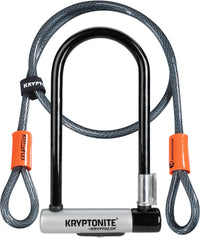
- Kryptolok Standard U-Lock with 4ft Kryptoflex cable, Sold Secure Gold, £49.99. A sensible everyday combination. Be clear about what the cable is doing: it is there to pick up the second wheel, not to secure the bike.
- Stronghold Ground Anchor, Sold Secure Diamond, £89.99. For the shed, garage or garden wall.
As a rough rule, if the lock costs less than about a tenth of the bike, you are probably under-locked. And no lock on this page, or any other page, is theft-proof. Anyone who tells you otherwise is selling something.
Quick answers
What Sold Secure rating should I get for an e-bike?
Gold is a reasonable everyday minimum. If you leave the bike in a city centre for long stretches, look at the Powered Cycle Diamond level, because that is the category tested against angle grinders.
Are two locks really better than one?
Yes, and the Met say so directly. Two different lock types mean a thief needs two different tools and more time on their knees in public.
Does a Diamond-rated lock stop an angle grinder?
No lock stops a grinder indefinitely. Powered Cycle Diamond products are tested against angle grinder attack, which is more than the Gold standard requires, but the honest answer is that a rating buys resistance and time rather than a guarantee.
Is a cable lock enough on its own?
No. Treat a cable as a way of catching a second wheel or an accessory while a U-lock does the real work.
Do I need to register my bike?
It is not a legal requirement, but police advice is to register the frame number on a national database. It costs nothing to do and it is the main route by which a recovered bike gets back to its owner.
Where to start
If you have just bought a bike and have not sorted security yet, do it in this order: record the frame number and register it, buy a Gold or Diamond U-lock sized to the stands you actually use, and fit a ground anchor wherever the bike sleeps. The locks and security kit we stock are in accessories; if you are unsure what fits your Roxform, email us and we will tell you.


