



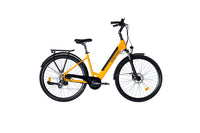

Two Roxform city bikes, the same upright step-through shape, and £200 between them. If you are choosing between the Stride S and the Roxform Stride S Plus, the honest answer is that most riders would be perfectly happy on either. But there are four differences that actually decide it, and outright speed is not one of them.
The short version
- Stride S, £1,250. One 18in frame size, 700C wheels, 8-speed Shimano Altus gearing, a 36V 250W AIKEMA rear hub motor rated at 45 Nm, four colours. The better buy if the single frame size suits you and you would rather keep the £200.
- Stride S Plus, £1,450. Three frame sizes, a Bafang rear hub motor rated at 50 Nm, a 504Wh Samsung battery, hydraulic disc brakes and a built-in front light. The better buy if you want the frame sized to you, or you want the longer-legged and lighter bike.
Both are sold direct from Hove, both are listed as Cycle to Work eligible, and both are ordinary legal e-bikes on British roads. Neither is quicker than the other where it counts, and we will explain why below.
What both bikes are, legally
The Stride S and the Stride S Plus are both electrically assisted pedal cycles (EAPCs). Under the rules published by the Department for Transport, an EAPC must have a continuous rated power output of no more than 250 watts, must have pedals that can be used to propel it, and the motor must not be able to propel the bike when it is travelling at more than 15.5 miles per hour. The minimum age to ride one is 14. You do not need a licence, and the bike does not need to be registered, taxed or insured.
That 15.5 mph cut-off applies to both bikes equally. Paying more does not buy a higher assisted speed, and we will not fit anything that raises it. In January 2025 the government published its response to a consultation on raising the power limit to 500 watts and allowing unrestricted throttle assistance, and decided not to take either proposal forward. The 250 watt and 15.5 mph baseline still stands.
Specifications side by side
| Stride S | Stride S Plus | |
|---|---|---|
| Price | £1,250 | £1,450 |
| Motor | AIKEMA rear hub, 36V 250W, 45 Nm | Bafang rear hub, 50 Nm |
| Battery | 36V 12.8Ah, around 460Wh | Samsung 36V 14Ah, 504Wh |
| Quoted range | Up to 40 miles | 60 to 80 miles |
| Charge time | 4 to 5 hours | 6 hours |
| Frame sizes | 18in, one size | 15in, 17in, 19in |
| Weight, excluding battery | 21.9 kg | 19 kg |
| Gears | 8-speed, Shimano Altus derailleur | 8-speed Shimano |
| Brakes | Shimano HD disc brakes | Hydraulic disc brakes |
| Wheels and tyres | 700C, 700x40C | 700C, 700x40C Kenda |
| Colours | Orange, Red, Light ivory, Gray | Orange, Beige |
Both weights exclude the battery, so each bike is heavier than that on the road. They are measured the same way, though, which is what makes them comparable: the Plus is the lighter of the two by nearly three kilograms.
Where the Stride S Plus earns the extra £200
Frame sizing is the big one. The Stride S comes in a single 18in frame. The Stride S Plus comes in 15in, 17in and 19in. If you are noticeably shorter or taller than average, that is the whole argument settled, because saddle height does not fix a frame that is the wrong length for your reach. Most bikes get sold on motor specifications and bought back on fit.
Torque goes from 45 Nm to 50 Nm. That is a real difference but a modest one, roughly eleven per cent. On a Brighton or Bristol gradient with shopping on the rack you will notice it pulling away from a standing start. On the flat you will not. Gearing does at least as much work as torque on a hill, which is one reason we would not choose between these two bikes on the motor alone. Our guide to hub motors and mid-drives goes into why both of these bikes use a rear hub.
Hydraulic disc brakes. The Plus is listed with hydraulic disc brakes; the Stride S is listed with Shimano HD disc brakes. In practice hydraulic systems need less hand force at the lever, which matters more than people expect on a heavy bike in wet weather. Both stop well; the Plus asks less of your fingers doing it.
A bigger battery, and a lighter bike. The Plus carries a 504Wh Samsung pack against roughly 460Wh on the Stride S, and weighs 19 kg against 21.9 kg, both excluding the battery. Less bike to move and more energy to move it with is a combination that shows up on longer days.
A built-in front light. The Plus has one. It is a small thing that removes one item from the list of things you can forget in October.
Where the Stride S still wins
It is £200 cheaper, which on a Cycle to Work agreement is a smaller monthly salary sacrifice for the same commute. It charges faster, at four to five hours against six, which matters if you are topping up at work between two legs of a journey. And it comes in four colours rather than two, which is often the deciding factor.
It also has a suspension fork, which takes the edge off broken tarmac. Both bikes run the same 700x40C tyres, a sensible width for British roads: enough for potholes, not so much that you are pushing a mountain bike to the shops.
Two numbers that need a caveat
Range. Our quoted figures are best case: flat ground, low assistance, a light rider, mild weather. Real journeys on either bike will land well short of the headline. It is worth doing the arithmetic. The Plus carries about nine per cent more energy and is a lighter bike, but that does not by itself account for the gap between "up to 40 miles" and "60 to 80 miles". Some of that difference is test conditions rather than hardware. Treat the Plus as the longer-legged bike of the two rather than as a specific mileage promise, and read our guide to e-bike range before you plan a commute around a number.
Charge time. The Plus takes longer because there is more battery to fill, which is not a fault. Always use the charger supplied with the bike, and charge it somewhere you would be happy to be standing if something went wrong, which means not overnight in a hallway that is also your only exit.
Quick answers
Is the Stride S Plus faster than the Stride S?
No. Both are EAPCs, so motor assistance stops at 15.5 mph on either bike. The Plus accelerates a little harder away from a stop because of the extra torque, but the top assisted speed is identical and set by law.
Which one is better for hills?
The Plus, marginally, on torque alone. But gearing, tyre pressure and rider weight all matter as much as the 5 Nm difference. If your commute is genuinely steep, the frame size that lets you put power down comfortably will do more for you than the motor rating.
Can I get either one through Cycle to Work?
Yes, both are listed as Cycle to Work eligible. There has been no single legal cap on scheme value since 2019, but your employer and their scheme provider set their own limit, and your saving depends on your tax band. Our Cycle to Work guide explains how it works, and your scheme provider will confirm the numbers for your situation.
Do I need insurance or a licence for either bike?
No. An EAPC does not need to be registered, taxed or insured, and you do not need a licence to ride one. Many riders insure their bike anyway against theft, which is a different question entirely.
I am between the 17in and 19in Plus frames. Which do I take?
Ride both if you can. Failing that, the smaller frame with the seatpost up is usually the more comfortable compromise for city riding, because you can still get a foot down at lights. Ask us before you order rather than after.
So which one
If the 18in frame fits you and you want the lower price, buy the Stride S. If you want the frame sized to you, a little more torque, hydraulic brakes and a light you cannot forget, buy the Stride S Plus and treat the £200 as money spent on fit rather than on speed.
If neither shape is right, the rest of the range is on our electric bikes page, including the folding Plico and the Porto longtail cargo bikes. And if you are within reach of Hove, come and ride them. Twenty minutes on both bikes will settle this faster than any table we can write.


