




Brakes are the spec most people skim past when they are choosing an electric bike, and they are the one that matters most when a van pulls out of a side road in the wet. Hydraulic disc brakes on an e-bike are now the default on anything built for British commuting, but mechanical discs are still fitted to plenty of good bikes, and the difference is not simply better and worse. Here is what separates them, what the law asks of you, and how to work out which you actually need.
Why brakes matter more on an electric bike
An e-bike is heavier than the bike it replaces. Our folding Plico weighs 19.30 kg without its battery and 22.48 kg with it, and that is one of the lighter bikes we sell. A longtail cargo bike with two children and a week's shopping on the back is heavier again.
The second difference is how much of the time you are travelling at speed. Assistance on a legal UK e-bike cuts off at 15.5 mph, but it holds you near that figure far more consistently than your legs would — up hills, into headwinds, and right up to the junction. More mass arriving at the same speed means more energy for the brakes to turn into heat, more often.
None of that makes an e-bike dangerous. It does mean the brakes are doing real work on an ordinary commute, and a system that felt adequate on a light hybrid can feel vague on a loaded e-bike.
What UK law actually requires
The law is less specific than people expect. The Highway Code's guidance for cyclists states that you "MUST ensure your brakes are efficient", citing regulations 6 and 10 of the Pedal Cycles (Construction and Use) Regulations. There is no legal requirement to fit hydraulics, and no stated stopping distance for a bicycle in the Code.
Separately, your bike has to be a legal electrically assisted pedal cycle in the first place: a motor with a continuous rated power of no more than 250 watts, assistance that cannot propel the bike above 15.5 mph, a minimum rider age of 14, and no licence, tax or insurance needed.
Braking performance is specified in the standards rather than the statute book. BS EN 15194:2017+A1:2023, published on 31 August 2023, is the current British Standard for electrically power assisted cycles, and it sets brake requirements at clause 4.3.5. Bicycle braking test methods sit in ISO 4210-4:2023, which covers braking performance at clause 4.6. A bike sold as road legal here should be built and tested to these, whichever brake type it carries.
Mechanical and hydraulic: the actual difference
Both types clamp a pad against a steel rotor bolted to the wheel hub. What differs is how the squeeze gets from your finger to the pad.
A mechanical, or cable-actuated, disc brake uses a steel inner cable inside a lined outer. Pull the lever and the cable pulls an arm on the caliper, which pushes the pad onto the rotor — on most designs from one side only, flexing the rotor against a fixed pad on the other.
A hydraulic disc brake replaces the cable with a sealed hose of fluid. The lever is a master cylinder; squeezing it pressurises the fluid, which drives pistons that push pads in from both sides at once.
| Mechanical disc | Hydraulic disc | |
|---|---|---|
| Lever effort for a given stopping force | Higher | Lower |
| Pad adjustment as it wears | Manual, by barrel adjuster or caliper screw | Self-adjusting on most designs |
| Winter grit and salt | Cable and outer degrade over time | Sealed system, unaffected |
| Roadside repair | Allen key and a barrel adjuster | Usually a shop job |
| Routine servicing | Cable replacement, pad alignment | Occasional bleed, pad replacement |
| Cost | Lower | Higher |
Why hydraulic disc brakes on an e-bike earn their keep
Three things, in order of how much they matter on a British commute.
Less hand effort. A hydraulic lever gives more braking force per unit of finger pressure. That is a comfort point on a dry Tuesday and a safety point in February, when your hands are cold, you are wearing gloves, and the bike is carrying a child seat and a pannier.
Consistency. As the pads wear, the pistons on most hydraulic calipers take up the slack automatically, so the lever bites in the same place in month nine as it did in week one. A cable system drifts, and the lever travels further until somebody adjusts it.
Weather. There is no cable to stretch, corrode, or fill with road grit. If you ride through salted winter roads, this is the difference that shows up first.
What hydraulics do not do: they will not fix a contaminated rotor, will not shorten your stopping distance on a wet painted road marking, and cannot be bodged at the roadside. A pulled hose or a soft lever means a trip to a shop. They also cost more, which is why they are not on every bike at every price.
Where mechanical discs still make sense
On a folding bike, mechanical brakes are a defensible choice rather than a corner cut. A folder gets handled, carried and put in a boot, and a cable survives that with less fuss than a hose running past a hinge. It can also be adjusted anywhere with one allen key, which suits a bike that lives away from your own garage.
That is why the Plico uses mechanical discs while our full-size city bikes use hydraulics. For a two-mile station hop the practical difference is small. For a ten-mile each-way run in winter, go full size.
What we fit, and where
| Model | Brakes | Motor | From |
|---|---|---|---|
| Stride S | Shimano hydraulic disc | Aikema rear hub | £1,250 |
| Stride S Plus | Hydraulic disc | Bafang, 50 Nm | £1,450 |
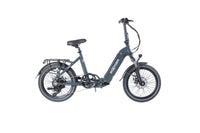
| Plico (folding) | Mechanical disc | Ananda, 45 Nm | £1,250 |
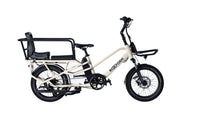
| Porto L (cargo) | Logan hydraulic disc | Bafang, 60 Nm | £1,990 |
The pattern is deliberate. Anything we expect to be ridden loaded, in traffic, through a winter, gets hydraulics. The folding bike, which is bought for portability, gets a system that is easier to live with away from a workshop.
Looking after either kind
- Keep oil away from rotors. Contaminated pads lose bite and squeal, and cleaning rarely recovers them. Shield the rotor when you lubricate the chain.
- Check pad thickness monthly. Expect pads to wear faster than on an unassisted bike used the same way, because they are stopping more weight more often.
- Bed new pads in. A series of firm stops from moderate speed on a quiet road lays an even layer of pad material onto the rotor.
- Mechanical brakes: take up pad wear at the barrel adjuster, and replace inner cables and outers once a year if you ride through winter.
- Hydraulic brakes: a lever that pulls closer to the bar than it used to, or feels spongy, wants bleeding. Fluid specifications differ between manufacturers and are not interchangeable, so check your bike's manual or let a shop do it.
Our e-bike servicing guide sets out when the rest of the bike needs attention alongside the brakes.
Quick answers
Are hydraulic disc brakes worth the extra on an e-bike?
For a bike ridden all year, in traffic, or carrying loads or children, yes — mostly for the reduced hand effort and the consistency as pads wear. For a light-use folder doing short, slow trips, the case is much weaker.
Does UK law require a particular type of brake on an e-bike?
No. The Highway Code requires that your brakes are efficient, citing the Pedal Cycles (Construction and Use) Regulations. It does not specify hydraulic, mechanical, disc or rim.
Can mechanical disc brakes be upgraded to hydraulic later?
Sometimes, but rarely for good value. You need levers, hoses, calipers and often rotors, and e-bike levers may carry motor cut-off switches that have to be matched. Buy the brakes you want on the bike.
Why do my brakes squeal in the rain?
A brief squeal on the first stop after rain is normal as water and surface grime clear from the rotor. Persistent squealing usually means contamination, a loose caliper or worn pads, and should be looked at.
Choosing a bike by its brakes
Treat brake type as a question about how you will ride, not a tick in a spec column. Daily miles in all weather, hills, or a loaded bike point to hydraulics. A short, flat, fair-weather hop lives happily with cables.
The Stride S Plus is our usual recommendation for a year-round commute, and the full range sits in electric bikes. If you are unsure, email us with the commute — distance, hills, what you carry — and we will say honestly whether the cheaper bike is enough.
Sources
- The Highway Code, Annex 1: You and your bicycle (GOV.UK)
- Electric bikes: licensing, tax and insurance (GOV.UK)
- BS EN 15194:2017+A1:2023, Cycles. Electrically power assisted cycles. EPAC Bicycles (BSI)
- ISO 4210-4:2023, Cycles — Safety requirements for bicycles — Part 4: Braking test methods (preview, ANSI webstore)


