




Potholes, hedge cuttings and broken glass end more British rides than mechanical failure ever does, and an e-bike makes every one of them harder on the tyre. The bike is heavier than the one it replaced, it usually carries more, and all of that rests on two contact patches the size of your palm. Sorting out e-bike tyres and puncture protection is the cheapest reliability upgrade available to you, and most of it costs nothing beyond a pressure gauge.
Why an e-bike is harder on tyres
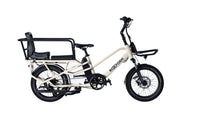
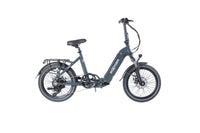
Weight is the obvious part. A Roxform Plico weighs 22.48 kg with its battery fitted; a Porto S is 27 kg before the battery goes in, and before a child seat or a week's shopping. Add a rider and a load and the tyre spends its life nearer the top of its load range than the bottom.
Speed is the less obvious part. A UK legal e-bike assists up to 15.5 mph, and on a flat commute that is the speed you hold rather than a number you touch occasionally, so you meet pothole edges and sunken drain covers more often at the speed where they do damage.
Then there is the road. In the year to March 2025 the Department for Transport recorded 17% of local authority unclassified roads in England in "red" condition — they should have been considered for maintenance — against 7% of B and C roads and 5% of A roads. Unclassified roads are the residential streets most of us actually cycle on.
Reading your sidewall before you buy anything
Three useful things are moulded into every tyre's sidewall: the size, the permitted pressure range, and on e-bike tyres an approval marking.
Sizes use the ETRTO format: nominal width in millimetres, then the bead seat diameter of the rim. A tyre marked 42-622 is roughly 42 mm wide on a 622 mm rim, the size usually sold as 700C. Inch markings such as 20 x 2.10 are less precise, which is why two tyres both called 20 inch may not fit the same wheel.
| Roxform model | Tyre fitted | Usual ETRTO equivalent |
|---|---|---|
| Stride S, Stride L, Valor S | 700 x 40C | 42-622 |
| Plico | 20 x 2.10 | 54-406 |
| Porto S | 20 x 2.4 | 62-406 |
| Porto L | 20 x 2.40 | 62-406 |
The tyre sizes are the ones published on our product pages; the ETRTO equivalents come from Schwalbe's size chart, not from a measurement of your wheel. Read your own sidewall before ordering, and ask us about any model not listed here.
The approval marking is the one most riders miss. A tyre marked E-25 is approved for pedelecs assisted to 25 km/h, the 15.5 mph class every bike we sell belongs to. E-50 denotes ECE-R75 approval, aimed at faster machines including speed pedelecs. You do not need an E-50 tyre for a UK e-bike.
Pressure matters more than which tyre you buy
There is no single correct number. Schwalbe's technical guidance puts it plainly: it is impossible to make a general recommendation on inflation pressure for a particular bicycle or tyre, because the right pressure depends mainly on the load the tyre carries. Narrower tyres and heavier loads need more; wider tyres and lighter loads need less.
The permitted range is printed on the sidewall, and the Highway Code's advice to cyclists is that tyres should be in good condition and inflated to the pressure shown on the tyre. Within that range, the surface decides. On smooth tarmac, higher pressure deforms the tyre less and rolls better. Off road that reverses, because a softer tyre follows the ground instead of bouncing off it. Broken urban tarmac sits closer to the second case than most riders assume.
- Start mid-range and adjust over a week of real riding.
- Run the rear higher than the front when loaded, because that is where the weight and the motor sit.
- Never go below the printed minimum. Schwalbe are blunt that too little pressure substantially raises puncture risk, and underinflated tyres crack at the sidewall.
- Check monthly at least. Losing about 1 bar a month is normal. Use a gauge, not your thumb.
E-bike tyres and puncture protection: what a belt actually stops
A protected tyre carries an extra layer between tread and casing. Schwalbe's Marathon Plus uses a 5 mm SmartGuard rubber belt; the e-bike specific Marathon E-Plus uses Smart DualGuard, a 4 mm SmartGuard layer backed by two layers of RaceGuard fabric, on a reinforced carcass Schwalbe rate to 136 kg per tyre.
That belt is very good at the things that push straight in: glass, flints, thorns, staples. It is close to useless against three others.
- Sidewall cuts. The belt sits under the tread, not around the sides.
- Pinch flats. An underinflated tyre struck on a pothole edge traps the tube against the rim. No belt prevents that; correct pressure does.
- Large objects. A screw or a shard driven in at speed will still go through.
The cost is real too: protected tyres are heavier, stiffer, harsher over small bumps and harder to lever onto a rim. On an assisted bike the motor hides most of that weight, which is a fair reason to fit them here and not to a road bike. Sealant is a partner rather than a replacement, because Schwalbe are clear that it cannot help with large punctures caused by cuts or snakebites. Carry a spare tube.
A puncture on an e-bike is not a roadside five minutes
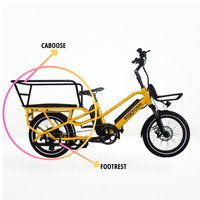
Most of our bikes drive through a rear hub motor, so the rear wheel comes with a motor cable and connector, torque washers that have to go back the right way round, and more mass than you expect. The Stride L and the Venturis are mid-drive, where the rear wheel behaves like any other bike's. Either way, a loaded cargo bike is not something you flip upside down at the kerb in the rain.
So spend on prevention rather than roadside kit, and learn how your rear wheel comes out before you need to. Tyre condition belongs on the same checklist as brake pads and chain wear, which we cover in our guide to e-bike servicing intervals.
Wet roads and side-on visibility
British grip problems are rarely about the tyre. They are painted lines, metal covers, wet leaves and diesel at roundabouts: brake earlier and cross them in a straight line rather than mid-turn.
Many touring and e-bike tyres carry a reflective strip in the sidewall, which puts a moving circle of light exactly where a driver emerging from a side road is looking. It is an addition to lights rather than a substitute — an EAPC must have working lights and reflectors between sunset and sunrise. The rest of the kit is in our guide to riding through a British winter.
Knowing when a tyre is finished
- The tread has squared off across the centre, usually on the rear first.
- You can see casing threads through the rubber, or a cut that reaches them.
- The sidewall is cracked or crazed, which is what a season of underinflation does.
- You are getting repeat punctures in the same part of the tyre.
- The tyre has a wear indicator and it has gone.
- On a hub-motor bike the rear tyre reaches all of this first, while the front still looks new.
Quick answers
What pressure should I run in my e-bike tyres?
Whatever falls inside the range printed on your sidewall, chosen for your weight and load. Start mid-range, higher when loaded, lower on rough surfaces, never below the minimum.
Do I need tyres made specifically for e-bikes?
For a 15.5 mph EAPC, a good tyre with a protection belt and a load rating suited to a heavy bike is enough. An E-25 marking covers this class; ECE-R75 and E-50 approval is aimed at faster pedelecs.
Is sealant worth adding?
Good insurance against thorns and small glass, no help with a cut sidewall or a pinch flat. Use it alongside a spare tube, not instead of one.
Can I fit wider tyres than the ones supplied?
Sometimes, but frame clearance, mudguard clearance and rim width all set limits. Send us your model and the size you want and we will tell you whether it fits.
Getting it right on your bike
If you ride a loaded longtail like the Porto L, pressure and load rating matter more than any other maintenance decision you will make this year. If you are still choosing a bike, ask about tyre width and clearance before you buy; the range is listed under electric bikes. Either way, buy a floor pump with a gauge — the least glamorous purchase in cycling and the one that pays back fastest.
Sources
- The Highway Code, Annex 1: You and your bicycle (GOV.UK)
- Electrically assisted pedal cycles (EAPCs) in Great Britain: information sheet (GOV.UK)
- Road conditions in England to March 2025 (Department for Transport)
- Schwalbe technical information: tyre pressure and rolling resistance
- Schwalbe tyre size chart, ETRTO equivalents (PDF)


