



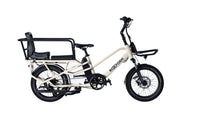
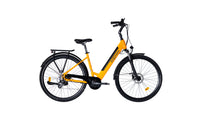
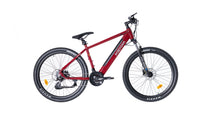
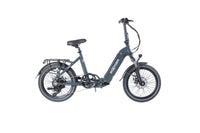

Commuting by e-bike in Brighton and Hove is easy right up to the moment the road tilts. The seafront is flat and fast. Almost everything north of it climbs. Whether an e-bike works here as daily transport, rather than a weekend toy, comes down to how you handle that one fact.
We are based in Hove, so this is our own commute as much as our customers'. Below is what actually matters locally: which hills you will meet, which routes join up and which do not, where you can leave a bike securely, and what the law allows.
Why the hills matter more here than the mileage
Most journeys across this city are short. The council describes Brighton and Hove as compact, but notes that its "challenging geography, such as narrow streets and hills" limits what can be built, and lists "hilliness and distance" among the main barriers to active travel. Its own design principles for new routes say steep gradients should be avoided where possible.
That shapes a commute in a specific way. Three miles along Hove seafront is nothing. Three miles from the seafront up to Hollingdean or Woodingdean is a different ride entirely, and it is the reason people stop cycling to work. The climbs that come up again and again locally — Elm Grove, Dyke Road, Ditchling Road, Wilson Avenue, Coldean Lane — all appear in the council's route planning precisely because they are the links between the flat coast and the neighbourhoods above it.
Assistance does not remove those climbs. What it does is turn them from an event into something you can do twice a day in work clothes. That is the honest claim. Anything stronger is marketing.
What 250W actually gives you on a local climb
Every legal e-bike in the UK works to the same ceiling. An electrically assisted pedal cycle must have pedals that can be used to propel it, a motor with a continuous rated power output of no more than 250 watts, and assistance that stops propelling the bike above 15.5 mph. You must be 14 or over. No licence is needed, the bike does not need to be registered, taxed or insured, and you cannot ride it on pavements.
Those limits are not about to move. In January 2025 the Department for Transport published the outcome of its consultation on raising the power limit to 500W and allowing "twist and go" throttle assistance without type approval, and confirmed it would "not take forward the proposals that were consulted upon".
Going uphill, the 15.5 mph cut-off is irrelevant, because you will not reach it. What counts is torque and gearing, which we go into in what a 250W motor can actually climb. For local purposes: 250W with sensible gearing will take an average rider up the long drags out of the city at a steady, unheroic pace. It will not make Elm Grove feel flat.
The routes that join up, and the ones that stop
The city has around 40km of designated permanent cycle routes, including part of the National Cycle Network. In the council's own consultation on its Local Cycling and Walking Infrastructure Plan, 54% of respondents said they were dissatisfied with the cycling environment, and the commonest complaints were a lack of safe routes, lanes that stop abruptly, and gaps in the network. One respondent put it plainly: "Cycle network is currently very piecemeal."
So it pays to know which corridors the council has actually prioritised, and roughly when.
| Corridor | What it is for | Council priority |
|---|---|---|
| A259 seafront (Marine Parade, Marine Drive, Madeira Drive, Wharf Road to Palace Pier) | The flat east-west spine and the quickest way across the city | Short term, under 3 years |
| A23 and Valley Gardens (Argyle Road to Patcham roundabout, A259 to Marlborough Place) | North out of the centre towards Preston Park and Patcham | Short to medium term |
| Western Road, Church Road, New Church Road | Hove to central Brighton at low gradient | Short to medium term |
| Lewes Road, north and south | The main run to the universities and Moulsecoomb | Medium term, under 5 years |
| Old Shoreham Road (Hangleton Road to Dyke Road) | Sheltered east-west alternative to the seafront | Medium term |
| Ditchling Road and Dyke Road | The climbs north, where assistance earns its keep | Short to medium term |
Two practical notes from riding it. The seafront is flat but exposed, and a headwind along the A259 will cost you more time than a moderate hill; Old Shoreham Road is the sheltered option when it is blowing. And the council runs an online cycle map and journey planner that lets you choose route features and print or save a custom PDF, which is more useful than a generic app when you are trying to plan around gradients rather than distance.
Where you actually leave it
Parking is the part people underestimate. An e-bike is heavier and worth more than the bike it replaces, and a large share of local housing is flats with no hallway to spare.
- On-street stands. The Valley Gardens scheme added 56 cycle stands, giving parking for 112 cycles, with a further 50 stands providing 100 more spaces.
- Cycle hangars. The council's on-street hangars hold up to six bikes each and have two locking points inside. A space costs £72 per year. The council has managed the spaces directly since April 2025, and a citywide rollout is planned.
- Indoors. Where there is no outside space and no hangar nearby, a folding bike is the honest answer. A Roxform PLICO folds small enough for a cupboard, a hallway corner or the space under a desk, which is also where you want to be charging it.
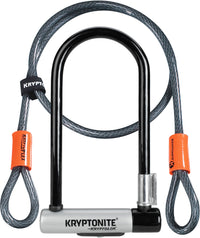
Whatever you choose, lock it properly. A city with this much cycling has the theft rate to match, and the mistakes are predictable: locking the wheel rather than the frame, using one lock on a bike worth four figures, or leaving it in the same spot at the same time every day. We set out what works in our guide to bike theft and lock ratings.
Mixing the bike with the train
A lot of local commutes are not within the city at all. Brighton to Lewes, Worthing, Haywards Heath, Gatwick or London is a train journey with a bike ride at each end, and that changes which bike makes sense. Full-size bikes are subject to operator reservations and peak-time restrictions; folded bikes are generally carried as luggage instead. We cover the detail in folding e-bikes and the train.
Quick answers
Will a 250W e-bike get me up the hills out of Brighton?
Yes, at a steady pace, if the gearing is sensible and you keep pedalling. Assistance is proportional to your own input, so a 250W motor shortens and flattens a climb rather than removing it.
Do I need a licence or insurance for an e-bike here?
No. A legal EAPC needs no licence, and does not need to be registered, taxed or insured. The minimum rider age is 14.
Can I ride an e-bike on the pavement or the promenade?
Not on pavements. Government guidance on EAPCs is explicit that you cannot ride one on a pavement, and an e-bike is treated as a cycle everywhere else, so local restrictions on cycling apply to it in the same way.
What does a council cycle hangar space cost?
£72 per year for a space in an on-street hangar that holds up to six bikes, managed by the council since April 2025.
Where to start
If your commute runs mostly along the coast with one climb at the end, a city bike is enough: the Roxform STRIDE S starts at £1,250. If you are carrying the bike up stairs or onto a train, start with the PLICO instead. The full range is in electric bikes. Tell us the route you actually ride and we will tell you honestly whether assistance solves it.


