



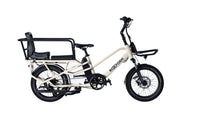
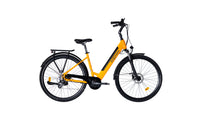
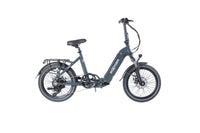

Half your journey is on a train, a bus or in a car boot, and the other half is on a bike. That is the commute that makes people hesitate between a folding e-bike and a full-size one, and it is the question we get asked most often in Hove. The folding vs city e-bike decision usually comes down to what happens at the two ends of the ride rather than the riding itself, so that is where this guide starts.
We make both. The Roxform Plico is our 20-inch folder and the Roxform Stride S is our 700C city bike. They cost the same: £1,250. That makes the choice refreshingly honest, because you are not weighing one against a cheaper compromise.
Folding vs city e-bike: the short version
Every figure below is from our own current spec sheets. Manufacturer range claims are best-case numbers, so treat them as a ceiling rather than a promise.
| Plico (folding) | Stride S (city) | |
|---|---|---|
| Price | £1,250 | £1,250 |
| Wheels and tyres | 20in, 20 x 2.10 | 700C, 700 x 40C |
| Motor | 36V 250W rear hub | 36V 250W rear hub, 45 Nm |
| Battery | 468Wh | 36V 12.8Ah (about 461Wh) |
| Claimed range | 40 to 60 miles | Up to 40 miles |
| Charge time | 4 to 6 hours | 4 to 5 hours |
| Gears | Shimano Altus, 7-speed | Shimano Altus, 8-speed |
| Brakes | Mechanical disc | Shimano hydraulic disc |
| Fork | Rigid | Suspension |
| Weight (without battery) | 19.3 kg | 21.9 kg |
What a mixed commute actually demands
Cycling is already a commuting habit rather than a weekend one for a lot of people. In the Department for Transport's National Travel Survey for 2025, commuting accounted for 32% of all cycling trips in England, just behind leisure at 35%, with an average of 15 cycling trips per person over the year.
A mixed commute adds a handling problem to that riding. You are not only pedalling; you are also lifting, wheeling through a ticket barrier, standing in a vestibule, or fitting something into a boot. Each of those moments has a size limit and a weight limit, and they are the parts a spec sheet never shows you.
Rules for carrying bikes on trains are set by each operator, not nationally, and folded bikes are generally treated far more leniently than full-size ones. We cover that in detail in our guide to taking a folding e-bike on UK rail. If a train is part of your journey every day, check your operator's policy before you choose a bike, not after.
The weight question, answered honestly
This is where folding e-bikes are oversold across the industry, so here is the plain version. The Plico is 19.3 kg without its battery and 22.48 kg with it. The Stride S is 21.9 kg without its battery. The folder saves you about two and a half kilos.
That difference matters when you are shuffling a bike into a hallway or a boot. It does not turn the Plico into something you carry up two flights of stairs each evening, and no e-bike at this price is that bike.
What folding really buys you is shape, not lightness. A folded Plico occupies a footprint you can tuck beside a desk, under a stairwell, in a car boot without dropping the rear seats, or in the luggage area of a train. A Stride S needs somewhere a whole bicycle can stand.
How they ride, and where the wheel size shows
Twenty-inch wheels feel quick and darty. They change direction with very little input, which is genuinely good in slow traffic and tight cycle parking, and they are less settled at speed over broken tarmac. The Plico runs 2.10in tyres to take some of that edge off, but it has a rigid fork, so you feel the road.
The Stride S rides the way a 700C bike does: calmer, steadier over potholes and tram-style surfaces, and more comfortable once you are past a couple of miles. It has a suspension fork and 40C tyres, which is a sensible width for British roads, and Shimano hydraulic disc brakes, which need less hand force in the wet than the Plico's mechanical discs.
Gearing is a smaller gap than it looks. Seven speeds on the Plico and eight on the Stride S both cover a city, and on a 250W pedelec the motor does much of the work a lower gear would otherwise do. If you live somewhere properly hilly, the eighth sprocket is welcome rather than decisive.
Range, in practice rather than on paper
The two batteries are very close: 468Wh in the Plico against roughly 461Wh in the Stride S. The claimed ranges are not close, because claimed ranges are measured under different assumptions rather than on your commute.
Real-world range moves with rider weight, hills, tyre pressure, cold, headwind, stop-start riding and how much assistance you select. Our guide to e-bike range for UK riders sets out how to estimate your own number. The short answer is to plan for the lower end of any claim and treat the rest as a margin.
Both bikes charge in four to six hours, so an overnight charge covers either. If you can charge at work as well, range stops being the deciding factor between these two at all.
Fit, storage and the two ends of the journey
- Flats and shared hallways. A folded bike is far easier to live with and to keep out of a communal escape route. Our guide to storing an e-bike in a flat covers the building-safety side.
- Office storage. If your workplace has no bike rack but will let you keep something beside your desk, that is a point for the Plico.
- Theft exposure. A bike you take indoors at both ends is a bike that is never locked outside. For many riders that is the strongest argument for folding.
- Rider height. The Plico comes with a choice of seatpost, a shorter one for riders roughly 5ft 2in to 5ft 5in and a standard one for 5ft 5in to 6ft 5in. The Stride S is an 18in step-through frame, which suits a wide range of riders and is easier to mount with a bag or a skirt.
Which one we would choose
Pick the Plico if any part of your journey involves a train, a coach or a car boot; if you live in a flat without secure ground-floor storage; or if the bike needs to come indoors at work. Accept that it rides like a small-wheeled bike and that it still weighs over 22 kg with the battery in.
Pick the Stride S if your commute is door to door on the road, if it is more than about five miles each way, or if you have somewhere secure to leave a full-size bike at both ends. You get the better brakes, the suspension fork, the extra gear and a calmer ride for the money.
Both bikes sit in our electric bikes collection, and both are available through Cycle to Work schemes and our UK dealer network. If you are near Hove and can get to a dealer, ride them back to back: ten minutes on each settles this question faster than any comparison table.
Quick answers
Are folding e-bikes legal on the same terms as full-size ones?
Yes. Both the Plico and the Stride S are electrically assisted pedal cycles. GOV.UK sets the rules: a continuous rated power output of no more than 250 watts, assistance that cuts off at 15.5 mph, usable pedals, and a minimum rider age of 14. No licence, tax, insurance or registration is required, and you can ride on cycle paths and anywhere else pedal bikes are allowed, but not on pavements.
Is the Plico light enough to carry up stairs?
Occasionally, not daily. It is 19.3 kg without the battery and 22.48 kg with it. Treat the fold as a way of making the bike smaller, not as a way of making it light.
Does the smaller wheel make the Plico slower?
No. Assistance on both bikes cuts off at the same legal 15.5 mph. The difference is in feel: 20in wheels are more agile and less settled, 700C wheels are steadier over rough tarmac.
Which has the better brakes?
The Stride S, which uses Shimano hydraulic discs. The Plico's mechanical discs stop well but ask for more hand force, particularly in the wet and on a long descent.
Can I buy either one through Cycle to Work?
Yes. Since 2019 there has been no single national cap on scheme value; your employer and their scheme provider set the limit, and the saving depends on your tax band. Ask your provider for the figures that apply to you.


