




Most of the nervousness people describe about cycling in traffic in the UK comes down to two things: not knowing where on the road they are supposed to be, and not knowing what is about to happen at the next junction. Both are learnable, and neither is really about bravery.
This is a guide to the positioning and junction habits that make a city ride predictable, and to what the Highway Code actually says — which is not what most drivers, or most riders, assume.
What the casualty figures say about junctions
The Department for Transport publishes a pedal cycle factsheet each year. In 2025, 79 pedal cyclists were killed in Great Britain and 4,311 were reported seriously injured.
The useful detail is where those collisions happen. Averaged across 2021 to 2025, 58.4% of cyclist fatalities did not happen at or within 20 metres of a junction — fatal collisions cluster on faster, more open roads. For serious injuries the picture flips: only 40.5% were away from a junction, and T or staggered junctions alone accounted for 34.5%.
The most commonly assigned road safety factor in fatal and serious collisions involving a cyclist was ineffective observation — by the driver, the rider, or both.
Put plainly: junctions are where most serious cyclist injuries happen, and the usual mechanism is somebody not looking properly. Almost everything below follows from that.
Where to ride: the centre of the lane, not the gutter
This is the single biggest change most riders need to make, and the Highway Code is explicit about it. Rule 72 tells cyclists to ride in the centre of the lane to be as clearly visible as possible — on quiet roads, in slower-moving traffic, and when approaching junctions. On busier roads where faster vehicles need to pass, you move left, but you still keep at least 0.5 metres from the kerb.
Hugging the kerb feels safer and is usually worse. It puts you in the part of the road with the drain covers and the broken glass, it invites drivers to squeeze past inside the lane, and it hides you at junctions behind the car in front.
| Situation | Where to be | Why |
|---|---|---|
| Quiet road, slow traffic | Centre of the lane | Rule 72 — you are visible and cannot be squeezed |
| Approaching any junction | Centre of your chosen lane | Rule 73 — removes the left-hook and the pull-out |
| Busy road, faster traffic behind | Left, but 0.5 m off the kerb minimum | Lets vehicles pass without inviting a close one |
| Passing parked cars | A door's width out | Rule 67 — a door opening is the classic city collision |
| Behind a van or lorry | Further back than feels necessary | Rule 66 — you need room if it stops suddenly |
The junctions that catch riders out
Four patterns account for most near misses on an urban commute.
- The left hook. A vehicle overtakes you, then turns left across your path. Rule 74 is blunt: do not ride up the inside of vehicles signalling or slowing to turn left. If a lorry or bus is beside you at a junction, the safest place is behind it.
- The side-road pull-out. A driver waiting to emerge looks for cars and does not register a bike. Rule 76 confirms that if you are going straight on, you have priority over traffic waiting to turn into or out of a side road — but priority is not protection. Move out towards the centre of the lane on the approach so you appear in the gap the driver is actually looking at.
- The right turn across you. Oncoming traffic turning right into a side road. Rule H3 says drivers should not cut across cyclists going ahead, and should wait for a gap. Assume some will not.
- Roundabouts. Rule 73 again: take the centre of your chosen lane where you can do so safely. If a roundabout feels beyond you, the Code explicitly allows you to dismount and wheel across on the pavement (rules 73 and 77). That is a legitimate choice, not a failure.
Where there is an advanced stop line at traffic lights, you may cross the first line while the signal is red but not the final one (rule 71). Use the box if it is empty and you can reach it safely — do not filter up the inside of a queue to get there.
What the 2022 Highway Code changes actually gave you
The January 2022 revision introduced a hierarchy of road users. Rule H1 puts the greatest responsibility on those in charge of the vehicles that can do the most harm — and makes clear that cyclists in turn carry a responsibility towards pedestrians. Rule H2 requires drivers and riders to give way to pedestrians crossing or waiting to cross at a junction you are turning into or out of, and tells cyclists to give way to pedestrians on shared-use tracks.
For overtaking, rule 163 asks drivers to leave at least 1.5 metres when passing a cyclist at speeds up to 30 mph, and more at higher speeds — and to wait behind if they cannot. Rule 167 tells them not to overtake at or approaching a junction, and to stay behind a cyclist approaching a junction or roundabout if they intend to turn left.
Knowing these rules is worth more for your decisions than for your arguments. They tell you which positions are defensible and where drivers are most likely to be in the wrong — not which positions are safe to assume.
Where an e-bike behaves differently
An electrically assisted pedal cycle gets you to 15.5 mph quickly and then stops helping; above that it is all legs. In UK terms an EAPC has a motor rated at no more than 250 watts, assistance that cuts out at 15.5 mph, a minimum rider age of 14, and no licence, tax or insurance requirement. We cover the detail in our guide to UK e-bike law in 2026.
In traffic, that profile helps more than it hurts. You clear a junction from a standing start at roughly the speed of the cars around you, which shortens the time you spend in the worst place to be. The things to adjust for:
- Drivers misjudge your speed. Someone pulling out of a side road sizes up a bicycle doing 10 mph, not one doing 15. Cover your brakes on every side-road approach.
- You are heavier. A city e-bike weighs more than an unassisted one, so braking distances are longer, particularly in the wet. Leave more gap than you think you need.
- Do not chase the cut-off. Sitting at 15.5 mph in a 20 mph zone is fine. Trying to hold it through junctions is where riders run out of options.
Being seen, especially after dark
Rule 60 is a legal requirement, not advice: at night your cycle must have a lit white front lamp and a lit red rear lamp, plus a red rear reflector. Flashing lamps are permitted, but a steady front light is better where there is no street lighting. Rule 59 is the softer one — bright or fluorescent clothing in daylight, reflective material after dark, and a correctly fitted helmet, which is recommended rather than required.
British winter commuting is mostly dark and often wet, so a hi-viz waterproof such as the Reflect waterproof jacket at £49.99 does two jobs at once. A Compact helmet is £29.99.
Building confidence without pretending
Confidence in traffic comes from repetition on roads you have chosen, not from toughing out roads you have not. Ride your commute once at the weekend. Pick the quieter parallel street even if it adds half a mile. Walk the bike through the one junction you dislike until you have watched how it behaves. If you ride locally, our guide to commuting by e-bike in Brighton and Hove covers the specific hills and routes.
And be honest about the limits. No amount of positioning makes a fast dual carriageway a sensible commuting route, and no e-bike changes that.
Quick answers
Is it legal to ride in the middle of the lane?
Yes. Highway Code rule 72 positively advises it on quiet roads, in slower traffic and on junction approaches.
Do I have to use a cycle lane?
No. Rule 61 says cycle facilities are there to help, but you may use your own judgement about whether to use them.
How much room should a driver leave when overtaking me?
At least 1.5 metres at speeds up to 30 mph, and more above that (rule 163). If they cannot, they should wait behind.
Is a helmet compulsory in the UK?
No. Rule 59 recommends a correctly fitted helmet; lights at night are the legal requirement (rule 60).
Can I get off and push if a junction looks bad?
Yes, and the Highway Code says so explicitly in rules 73, 74 and 77.
Where to start
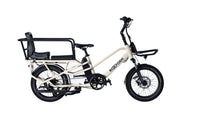
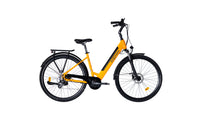
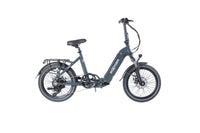
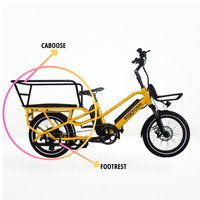
A bike that is upright, geared sensibly and quick away from the lights makes traffic far less stressful than a twitchy one. The Roxform Stride S is our city commuter and starts at £1,250; the rest of the range, including step-through and cargo models, is in Electric Bikes. We are in Hove, so if you want to ride something on real roads before buying, get in touch.


