



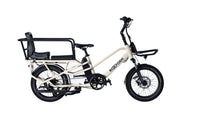
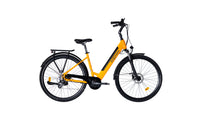
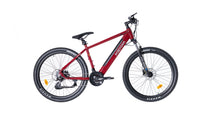
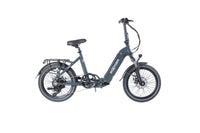

Every few weeks someone asks us for a faster e-bike. Usually they have read about a speed pedelec, a bike that keeps assisting to around 28 mph instead of cutting off at 15.5 mph, and they want to know whether we can get hold of one. The short answer is that we could, and we choose not to. Speed pedelec UK law does not treat these machines as bicycles at all, and once you follow the rules properly the result is a moped that happens to have pedals.
Here is what the law actually says, what owning one would mean in practice, and why we think almost nobody asking the question really wants the answer.
What makes an e-bike legally a bicycle
In Great Britain the category is the electrically assisted pedal cycle, or EAPC. According to GOV.UK, an EAPC must have pedals that can propel it, a motor with a continuous rated power output of no more than 250 watts, and a motor that cannot propel the bike when it is travelling at more than 15.5 mph. The rider must be 14 or over. There is no licence, no registration, no road tax and no compulsory insurance.
The bike itself also has to be marked with its continuous rated power output and the manufacturer, plus either the battery voltage or the maximum speed the motor can propel it.
Meet all of that and you can ride on cycle paths and anywhere else pedal cycles are allowed. Pavements are still out.
Speed pedelec UK law: what the vehicle categories actually say
Speed pedelecs are not a British invention and they are not covered by a separate British rule. They sit inside the European type-approval framework for two- and three-wheel vehicles, Regulation (EU) No 168/2013, which was retained in UK law. That regulation divides light two-wheel powered vehicles into sub-categories, and the detail is where the problem lies.
| Category | What it is | Power ceiling | Speed |
|---|---|---|---|
| EAPC | Treated as a pedal cycle in GB | 250 W continuous rated | Assistance cuts off at 15.5 mph |
| L1e-A | Powered cycle | 1,000 W | Auxiliary propulsion cuts off at 25 km/h (15.5 mph) |
| L1e-B | Two-wheel moped | 4,000 W | Maximum design speed up to 45 km/h (28 mph) |
Note what L1e-A requires: the assistance still has to stop at 25 km/h. A speed pedelec, by definition, keeps assisting past that. Annex I of the regulation says any L1e vehicle that fails the L1e-A criteria falls into L1e-B instead. So a 45 km/h pedal-assist bike is an L1e-B two-wheel moped. Not a bicycle with a generous motor. A moped.
What that means on a British road
GOV.UK is blunt about what happens to an electric bike that does not meet the EAPC rules. It is treated as a motorcycle or moped, which means it must be registered and taxed, you need a valid driving licence, you must wear a motorcycle helmet that meets British safety standards, and the machine must be insured. If it is not insured you may be fined and the police may seize it.
The part that catches people out is the last one: you can ride it on the road only. Not on cycle tracks and not in cycle lanes.
Think about what that removes from a typical British journey. The towpath section, the segregated lane along the seafront, the shortcut through the park, the bit of the National Cycle Network that avoids a nasty roundabout. All of it off limits. For a commute in Brighton and Hove, or any town where the good route is the traffic-free route, that is most of the value of the bike gone.
Then there is the licensing. To ride a moped on public roads you must be at least 16, hold a provisional licence with the right entitlement, and complete compulsory basic training. After CBT you have two years to pass the theory and practical tests or you have to do CBT again. The bike needs a valid V5C, must be taxed, and needs adequate insurance.
The two-wheeled summary
- Registration, tax and a number plate on the vehicle
- A driving licence and CBT, with a minimum age of 16 rather than 14
- Motorcycle-standard helmet, not a cycling helmet
- Motor insurance
- Road use only, no cycle lanes or cycle tracks
- Type approval as an L1e-B vehicle before it can be registered
Set against that, an EAPC needs none of it. That gap is not a technicality. It is the whole reason e-bikes have been useful in this country.
What about "off-road mode" and derestricting?
Plenty of imported bikes ship with a setting that unlocks assistance above 15.5 mph, sold as an off-road or private-land mode. GOV.UK's EAPC information sheet states plainly that an off-road mode allowing motor propulsion above 15.5 mph is not compliant with the EAPC regulations, and that such vehicles are treated as motor vehicles.
That classification travels with the bike. It does not switch off when you switch the mode off. We do not fit derestriction kits, we do not advise on dongles, and we will not help anyone unlock a bike beyond 15.5 mph for road use. If a bike you are considering has that feature, assume it is a motor vehicle and price in the consequences.
Throttles are the other grey area. A bike that can be propelled up to 15.5 mph without pedalling needs type approval, which the manufacturer or importer should have obtained before sale; approved bikes carry an approval number. Walk assist up to 3.7 mph sits outside that requirement.
The limits are not about to change
In February 2024 the Department for Transport consulted on raising the EAPC power limit from 250 W to 500 W and on allowing twist-and-go throttle assistance up to 15.5 mph without type approval. The outcome was published on 28 January 2025. The government decided not to take either proposal forward, citing a significant lack of evidence for the claimed benefits, with most of the main stakeholder organisations opposed. Of 2,121 responses, 51.34% opposed the 500 W change and 52.95% opposed the throttle change.
The document leaves the door open to revisiting power limits in the longer term as part of wider micromobility work, but nothing has changed since. As of today, 250 W and 15.5 mph remain the baseline, and we design and specify around them.
Quick answers
Is a speed pedelec illegal in the UK?
No. It is legal if you treat it as what it is: register it, tax it, insure it, hold the right licence and wear a motorcycle helmet. It is illegal to ride one as though it were a bicycle.
Can I ride a speed pedelec in a cycle lane?
No. GOV.UK states that a bike which does not meet the EAPC rules can be ridden on the road only, not on cycle tracks or cycle lanes.
Do I need insurance for a normal e-bike?
Not by law, if it is a compliant EAPC. Theft cover is a separate question and worth having.
How old do you have to be?
Fourteen for an EAPC. Sixteen for a moped, plus a provisional licence and CBT.
Will Roxform ever sell one?
Not while the classification stands. We would rather sell a bike you can take anywhere a bicycle can go.
What we build instead
Our view is that 15.5 mph is a sensible cruising speed for British roads, and that the engineering effort is better spent on the things that actually make a journey quicker: gearing that lets you hold that speed on a climb, brakes that work in the wet, and a battery that gets you home. The Stride S at £999 pairs an 8-speed Shimano Altus drivetrain with Shimano HD disc brakes and a 36V 12.8Ah battery. The Stride S Plus at £1,250 steps up to a 50Nm Bafang rear hub motor and a Samsung battery for hillier commutes.
Both are EAPCs, so they go where bicycles go. If you want the full picture of the rules before you buy, our guide to UK e-bike law in 2026 covers the ground, and what a 250W motor can actually climb deals with the question underneath most speed pedelec enquiries. Browse the range in electric bikes, or come and ride one in Hove.
Sources
- GOV.UK — Riding an electric bike: the rules
- GOV.UK — Electrically assisted pedal cycles in Great Britain: information sheet
- legislation.gov.uk — Regulation (EU) No 168/2013, Article 4 and Annex I
- Department for Transport — Proposed changes to legislation for electrically assisted pedal cycles: outcome, 28 January 2025
- GOV.UK — Ride a moped or motorcycle


