




Nobody buys an e-bike wondering about the battery. Two or three years in, everybody does, usually because the range has quietly shrunk and the question becomes a financial one. An e-bike battery lifespan is not a fixed number of years, and it is not luck either. A lithium-ion pack wears out in ways that are well understood, and most of what shortens one is a handful of habits rather than mileage.
Worn out does not mean dead
Batteries almost never fail suddenly. They fade. The industry measures this as state of health, and the Government's own research on e-bike and e-scooter batteries defines it plainly: 100% is the as-new condition, and "80% SoH means the cell or battery has permanently lost 20% of its as-new storage capacity".
That matters because 80% is the figure most of the industry treats as end of useful life, and it is not the same as broken. A pack at 80% still works — it just does four-fifths of what it used to, permanently.
Here is what that looks like on bikes we actually sell, using the capacities from our own listings:
| Model | Battery as new | Quoted range as new | Same pack at 80% health |
|---|---|---|---|
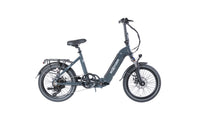
| Plico (folding) | 468Wh | Up to 40–60 miles | About 374Wh, so roughly 32–48 miles |
| Stride S | 36V 12.8Ah, about 461Wh | Up to 40 miles | About 369Wh, so roughly 32 miles |
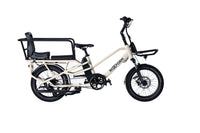
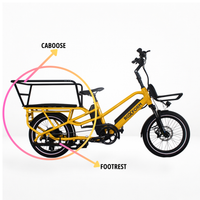
| Porto L (longtail cargo) | 936Wh dual pack | Up to 62 miles | About 749Wh, so roughly 50 miles |
Those range figures are best-case numbers, and they shrink with hills, cold, loads and headwinds — our guide to what an e-bike will really do on a charge goes through that. The point of the table is the relationship, not the miles: lose a fifth of the capacity and you lose a fifth of the range.
Two clocks are running, not one
A pack ages in two separate ways, and they add up.
- Cycle ageing is wear from use. One cycle is one full charge's worth of energy in and out, whether you take it in a single long ride or in ten short ones. This is the clock riders think about.
- Calendar ageing is wear from simply existing. A pack sitting in a shed degrades even if it never moves, and how fast depends almost entirely on its temperature and how full it is while it sits.
This is why a five-year-old bike with 400 miles on it can have a worse battery than a two-year-old bike with 4,000. For most commuters doing a few miles each way, calendar ageing is the bigger clock — which is good news, because it is the one you control.
What actually accelerates the wear
Heat. This is the big one, for both clocks. London Fire Brigade's guidance is to store batteries in cool, dry places, avoid leaving them in direct sunlight for long periods, let a battery cool down before charging after riding, and never charge a battery that already feels very hot. A pack left on a south-facing windowsill all summer is being aged deliberately.
Charging a cold battery. Less widely known, and genuinely damaging. The Government's PLEV battery safety research describes how, at cold temperatures, "progressive chemical changes within the cell, particularly lithium plating on the anode, can lead to an internal short-circuit". Lithium plating is permanent capacity loss and a safety risk in one. Bring the bike or the battery indoors and let it reach room temperature before plugging it in. Do not charge a frozen pack at all.
Sitting at 100% for weeks. A fully charged cell is a chemically stressed cell. Unplug once charging is finished — there is nothing to gain from leaving a pack connected for days, and it is the reason battery makers specify a part-charged pack for long storage rather than a full one.
Sitting empty for months. The opposite problem. A pack left flat all winter can self-discharge below the voltage its management system will charge from, which is a problem no amount of patience fixes. If the bike is being put away, put it away part-charged, and check it occasionally.
Physical damage. A knock, a drop or a soaking need not be visible to have done something. Lithium-ion packs are not waterproof; avoid deep water and never pressure-wash an e-bike.
What matters less than people think
- Partial charges do not hurt. Topping up from 60% to 80% is not "a cycle" and does not use one up. Lithium-ion has no memory effect — the advice to fully discharge a battery belongs to a different chemistry and is actively bad here.
- Cold riding is not cold damage. A winter commute will cost you range on the day, sometimes a lot of it, and you get it back when the pack warms up. Riding in the cold is fine; charging in the cold is not.
- Mileage alone is a poor predictor. How the pack is stored between rides tells you more than the odometer does.
The habits that add years
- Use the charger that came with the bike, and if you need another, get a genuine one from the manufacturer.
- Unplug when charging is finished rather than leaving it connected overnight. London Fire Brigade advise never charging unattended or while asleep in any case.
- Charge indoors at room temperature, on a hard flat surface, away from your main route out of the building.
- Let the pack cool after a hard ride before you plug it in.
- If the bike is going away for a month or more, leave the battery at somewhere around half charge, somewhere cool and dry, and top it back up to half every couple of months.
- Take the battery off the bike in winter rather than leaving it in an unheated shed or outside overnight.
None of it is onerous, and together it is the difference between a pack still comfortable at five years and one that disappoints at three.
Replacing one, and where not to buy it
Eventually a pack reaches the point where the range no longer fits the journey. When it does, buy the replacement from the manufacturer or an authorised dealer, and nowhere else. The Government's PLEV research puts a number on why: in the OPSS consumer survey that fed into it, 41% of owners who had bought a separate battery reported a safety incident, and 48% of those who had bought a separate charger — against 10% of owners who had bought neither.
Never have a pack opened, rebuilt or re-celled by anyone other than the manufacturer or an authorised repairer, and never fit a universal charger. If a pack swells, gets hot, hisses, smells or loses range suddenly with no explanation, stop charging it and speak to the seller. Our separate guide to e-bike battery safety, charging and storage covers the OPSS statutory guidelines and the BS EN 15194 standard in full.
Worth asking before you buy, too: a brand with no UK presence and no replacement pack available is selling a bike with a built-in expiry date.
Quick answers
How long does an e-bike battery last? There is no single figure, and any seller quoting one precisely is guessing. Expect several years of normal commuting before the loss is noticeable, with storage temperature and resting charge level mattering more than mileage.
What does 80% state of health mean? The pack has permanently lost 20% of its original capacity, so gives about four-fifths of the original range. It is the figure commonly treated as end of useful life.
Should I run the battery flat before charging? No. That advice comes from older battery chemistries. Partial charges are fine and sitting at empty for long periods is harmful.
Is it bad to leave it on the charger overnight? Yes, on two counts. It holds the pack at full charge, which ages it, and London Fire Brigade advise not charging unattended or while asleep.
What charge should I store it at over winter? Around half, somewhere cool and dry, with a top-up every couple of months. Not full, not empty, and not in an unheated shed.
What we do about it
Every Roxform is sold with its own matched charger, and we keep replacement batteries available for the models we sell — the Porto L listing, for instance, includes a two-year warranty. If you have a question about a pack on a bike you already own, ours or anyone's, email us — we would rather give you a straight answer than sell you a new bike.
If you are still choosing, the full range of electric bikes is here. The folding Plico suits anyone in a flat, simply because a bike that comes indoors is a battery that never spends a January outside; the Stride S is the straightforward city option if storage is not the constraint.
Sources
- Personal Light Electric Vehicle (PLEV) Battery Safety Research Final Report, WMG for OPSS, January 2025
- OPSS — Statutory guidelines on lithium-ion battery safety for e-bikes
- London Fire Brigade — How to charge e-bikes and e-scooters safely
- London Fire Brigade — Heat, cold and rain: how weather conditions affect e-bikes and e-scooters


