



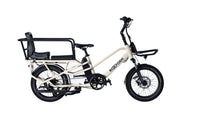
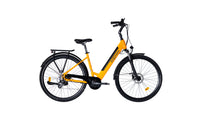
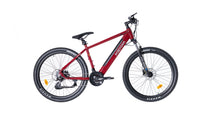
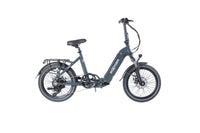

You want one bike that can handle a canal towpath, a bridleway on the Downs and the ride into work on Monday. Looking at the two Roxform models built for rough ground, the Gravion and the Venturis, they read almost identically on paper: same battery, same legal 250W limit, same wheel options. The difference is in how the power reaches the ground, and that decides which one you should buy.
Both are legal electrically assisted pedal cycles, so everything below assumes an electric mountain bike in the UK sense: 250W continuous rated power, assistance cutting out at 15.5 mph, working pedals, no licence, tax or insurance needed, minimum rider age 14.
The short answer
Buy the Gravion if most of your riding is roads, cycle paths, parks and dry, firm tracks, with the occasional bridleway. Buy the Venturis if steep, loose or muddy ground is a regular part of your week, or if you load the bike and still want to get up a 15 per cent lane without standing on the pedals.
The Venturis is £400 more. That money buys torque and a better drivetrain, not more battery.
Where the two bikes actually differ
| Roxform GRAVION | Roxform VENTURIS | |
|---|---|---|
| Price | £1,250 | £1,650 |
| Motor | Aikema rear hub, 36V 250W | Bafang M400 mid-drive, 36V 250W |
| Torque | 45 Nm | 80 Nm |
| Battery | LG cell Li-ion, 36V 12.8 Ah, 460.8 Wh | Li-ion, 36V 12.8 Ah, 460.8 Wh |
| Quoted range | Up to 50 miles | Up to 40 miles |
| Weight | 21 kg | 23 kg |
| Drivetrain | Shimano Altus, 24-speed (3x8) | Shimano Deore, 38T chainring, 11–36T cassette |
| Fork | Suntour suspension fork | Suntour MLO suspension fork |
| Brakes | Shimano hydraulic disc | Shimano hydraulic disc |
| Wheels and tyres | 27.5in or 29in, 2.10in | 27.5in or 29in, 2.25in Maxxis |
| Frame | 18in aluminium | Aluminium alloy |
| Charge time | 4–6 hours | 4–6 hours |
| Colours | Red, Basalt Grey | Black, Navy |
45 Nm or 80 Nm: what the numbers feel like
Torque is the figure that changes the ride, and it is the one most buyers skip over. The Gravion's rear hub motor pushes the back wheel directly. It is smooth, quiet and completely adequate on tarmac and firm gravel. On a long, steep, loose climb it runs out of shove before your legs do, and because it cannot use the gears, you cannot help it much by changing down.
The Venturis puts its motor at the cranks, so the assistance goes through the Deore drivetrain. Drop into a low gear and the motor's 80 Nm is multiplied in exactly the way your own pedalling is. That is why a mid-drive climbs loose, steep ground so much better than a hub motor of the same rated power, and why it holds a steady speed on a gradient instead of surging and fading.
Weight distribution matters too. The mid-drive's mass sits low and central, which keeps the front wheel planted on a climb. The hub motor's mass is behind the saddle, which is fine on a road and noticeable when you lift the back of the bike over a stile. We have written separately about how hub motors and mid-drives compare on a British commute, and about what a 250W motor can actually climb.
What neither bike is
This is the part a specification table will not tell you. Both bikes are hardtails with a suspension fork and no rear shock. They are built for tracks, bridleways, forest roads and rough lanes, not for drops, jumps or black-graded descents at a trail centre. If that is your riding, you want a full-suspension bike with a longer-travel fork, and neither of these is it.
Neither is light, either. At 21 kg and 23 kg they are twice the weight of an unassisted hardtail. Carrying one up a flight of stairs is a job, and if the battery is flat you will feel every kilogram.
And neither will go faster than 15.5 mph under power, on any surface. The cut-off is a legal requirement, not a setting. We will not fit or advise on anything that removes it.
Where you can ride an electric mountain bike in the UK
Because a legal EAPC counts as a pedal cycle, the rules are the cycling rules, not vehicle rules. The Department for Transport's guidance is explicit that you can ride one "on cycle paths and anywhere else pedal bikes are allowed", and that you cannot ride it on the pavement.
- Bridleways in England and Wales: cyclists have a statutory right of way under section 30 of the Countryside Act 1968, and must give way to pedestrians and people on horseback.
- Public footpaths: no right to cycle. A footpath is for walkers.
- Byways and restricted byways: open to cycles.
- Forestry England land: waymarked cycle trails, cycle-permissible rights of way and stone-based forest roads. Forestry England's own position is that "as e-bikes are legally considered pedal cycles, they can be used on any trails, public rights of way and public highways that pedal cycles are permitted".
- Scotland: statutory access rights cover cycling on paths and off-path, exercised responsibly, and e-bikes are treated the same as any other bike.
Private land is different. A landowner, a trail centre or a park can set its own conditions, and a few do restrict e-bikes regardless of the law. Check before you turn up.
Range, and why the Venturis quotes less from the same battery
Both bikes carry 460.8 Wh. Roxform quotes up to 50 miles for the Gravion and up to 40 miles for the Venturis, and those are best-case figures: a lighter rider, low assistance, flat ground, mild weather and firm surfaces.
The Venturis quotes less because it is designed to be used harder. More torque on demand, 2.25in knobbly tyres, two more kilograms and the kind of terrain that keeps the motor working all mean more watt-hours per mile. On a hilly 20-mile ride in January, expect both bikes to come in well under their headline numbers. Our guide to e-bike range for UK riders sets out the arithmetic.
Which one to buy
If you are honest that nine rides in ten are commuting, errands and firm cycle paths, the Gravion is the better value and the lighter bike to live with. If the tenth ride is the one you actually bought the bike for, and it involves mud and gradient, buy the Venturis: you cannot add torque later.
Quick answers
Is an electric mountain bike legal on bridleways in the UK?
A legal EAPC is treated as a pedal cycle, and cyclists have a right of way on bridleways in England and Wales under the Countryside Act 1968. You must give way to walkers and horse riders. Footpaths are not included.
Do I need a licence or insurance for either bike?
No. Government guidance confirms an EAPC needs no licence and does not need to be registered, taxed or insured. You must be 14 or over to ride one.
Is 80 Nm worth £400 more?
It is if you ride steep or loose ground regularly. On tarmac and firm tracks the Gravion's 45 Nm hub motor does the job, and the extra money buys you nothing you will notice.
Can I get either bike through Cycle to Work?
Typically yes. There has been no single legal cap since 2019, so the limit is set by your employer and their scheme provider, and the saving depends on your tax band. Ask your provider for the figures that apply to you.
Which wheel size should I choose?
Both come in 27.5in and 29in. The 29in rolls over roots and potholes more easily and suits taller riders; the 27.5in is a little more manoeuvrable and usually the better fit if you are shorter.
Have a look at both
The Gravion and the Venturis sit next to each other in our electric bikes collection, and both are available through our UK dealer network if you would rather ride them before deciding. If you tell us the gradient of your worst regular hill and what you will be carrying, we will tell you which one we would put you on.


