




Two e-bikes sit side by side in a listing. One shouts 1,000W peak and 80Nm; the other quietly says 250W continuous and 50Nm. On paper the first looks like twice the bike. In practice only one of those numbers is the figure UK law recognises, and only some of the rest will change how the bike feels on a Tuesday morning. Here is how to read an e-bike spec sheet properly: torque in Nm, watts, watt-hours and cut-off speed, and which lines we would check first.
Continuous rated power is the only wattage that counts
For a bike to be an electrically assisted pedal cycle (EAPC) in Great Britain, the motor must have a continuous rated power output of no more than 250 watts, the bike must have pedals that can propel it, and the rider must be 14 or over. An EAPC needs no licence, and does not need to be registered, taxed or insured.
Note the wording: continuous rated. That is the power the motor can sustain, measured to a standard, not the brief figure a controller might allow under load. A listing that leads with "1,000W peak" is not quoting the regulated number, and a bike whose continuous rated power genuinely exceeds 250W is not a bicycle in law. It is classed as a motorcycle or moped: registration, tax, a valid driving licence, insurance and a motorcycle helmet to British safety standards.
This is settled ground, not a loophole waiting to open. The Department for Transport consulted on raising the limit to 500W and on allowing unrestricted "twist and go" throttle assistance, and on 28 January 2025 published its decision not to take either proposal forward.
Torque in Nm: what it tells you, and what it does not
Torque, quoted in newton metres, is turning force. Watts describe how much work the motor can do over time; Nm describes how hard it can shove at the moment you need it. You feel torque pulling away from a standstill at lights, carrying shopping, or grinding up a short, steep hill. You barely feel it holding 14 mph on the flat.
As a rule of thumb we use when fitting riders: roughly 40 to 50Nm is comfortable for flat-to-rolling city riding, while 60 to 80Nm earns its keep on loaded cargo bikes and sustained climbs. Three caveats matter more than the number itself.
- There is no mandated marketing test for a torque figure, so quoted Nm from two different brands is not reliably like for like.
- Gearing changes everything. A low enough gear lets a modest motor climb what a bigger one struggles with — we covered this in what a 250W motor can actually climb.
- Where the motor sits on the bike changes how that torque arrives at the back wheel, so a hub motor and a mid-drive quoting the same Nm will not feel the same.
Watt-hours, not amp-hours
Battery capacity is the single best predictor of how far you will get, and the only honest unit for it is the watt-hour (Wh). Watt-hours are volts multiplied by amp-hours: a 36V, 14Ah battery is 504Wh. Quote the amp-hours alone and the number is meaningless until you know the voltage — 14Ah at 48V is 672Wh against 504Wh at 36V, a third more energy for the same headline figure.
When a listing gives only Ah, do the multiplication yourself before comparing. And treat any single range figure with suspicion: real range depends on rider weight, hills, wind, temperature, tyre pressure and assistance level. We set out the honest version in how far an e-bike really goes.
Speed: 15.5 mph is a ceiling, not a performance claim
The motor must not be able to propel the bike at more than 15.5 mph. BS EN 15194, the standard these bikes are built to, puts it in metric and adds the behaviour: motor output is progressively reduced and finally cut off as the bicycle reaches 25 km/h, or sooner if the rider stops pedalling. A bike that can be propelled up to 15.5 mph without pedalling at all needs separate approval.
So cut-off speed is not a differentiator between compliant bikes — they all stop assisting at the same point. You can still pedal faster than 15.5 mph; you just do it under your own power. We will not help anyone derestrict a bike, fit a dongle or raise that cut-off for road use: it takes the bike out of EAPC class entirely.
The standards line matters more than the headline numbers
The most important line on a spec sheet is often the least exciting one. BS EN 15194:2017+A1:2023, Cycles. Electrically power assisted cycles. EPAC Bicycles, covers design, assembly and testing, including electrical circuits and charging for systems up to 48V DC. It also provides a presumption of conformity under the Supply of Machinery (Safety) Regulations 2008.
For the battery specifically, the Office for Product Safety and Standards published statutory guidelines on lithium-ion battery safety for e-bikes on 12 December 2024. Those guidelines point to BS EN 50604-1:2016+A1:2021 for the battery itself alongside BS EN 15194 for the bike, require that a battery's protection system prevents thermal runaway caused by charging with an incompatible charger, and expect producers to supply the information needed to source a compatible one. The practical reading for you: if a listing cannot name the standards it meets, that absence is the specification. Always charge with the charger supplied with the bike.
What each number is actually worth
| Spec line | What it tells you | What to watch for |
|---|---|---|
| Continuous rated power (W) | Whether the bike is legally a bicycle in Great Britain | "Peak" wattage quoted instead; anything over 250W continuous |
| Torque (Nm) | Pull from standstill, on hills and under load | No standard test behind it; ignore it in isolation from gearing |
| Battery capacity (Wh) | Energy on board — the best single range indicator | Ah or V quoted alone; convert before comparing |
| Assistance cut-off | Nothing, between compliant bikes — it is fixed at 15.5 mph | Any figure above it, or throttle-only propulsion |
| Standards compliance | That the bike and battery were tested to something | No standard named anywhere in the listing |
| Weight, brakes, gearing | How the bike behaves above 15.5 mph and with the motor off | Kerb weight omitted; brake type vague |
Reading a real spec sheet: the Stride S Plus
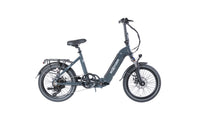
Our own listing for the Stride S Plus, at £1,450, gives a 50Nm Bafang rear hub motor, Samsung battery cells, Shimano gearing and hydraulic disc brakes. Read against the table above: 50Nm is a sensible city figure rather than a cargo or mountain one, the rear hub keeps the drivetrain simple, and the hydraulic brakes are the line we would actually argue matters most on a British winter commute.
What it does not claim: it is not a mid-drive, it will not out-climb a torquier bike on a 15% gradient with a full load, and its assistance stops at 15.5 mph like everything else we sell. If you want the same shape of bike for less, the Stride S is £1,250; if your riding is genuinely off-road, the Gravion is also £1,250 and built for it.
Where to start
Our order of reading is: standards first, then watt-hours, then torque in the context of gearing and your actual hills, then weight and brakes. Headline peak wattage comes last, because it tells you about the listing rather than the bike. If you want to test that against a real spec sheet, start with the Stride S Plus and work down the lines. We are in Hove and happy to be asked awkward questions about any of them.
Quick answers
Is higher Nm always better on an e-bike?
No. More torque helps from standstill, on hills and under load, but it does nothing for cruising, adds weight and cost, and can be matched by lower gearing on a modest motor.
Why do some listings say 500W or 1,000W if the limit is 250W?
They are usually quoting peak rather than continuous rated power. The legal figure is continuous rated power, capped at 250W for an EAPC.
How do I convert amp-hours to watt-hours?
Multiply amp-hours by the battery's nominal voltage. A 48V, 10.4Ah battery is roughly 499Wh.
Does a bigger motor mean a higher top speed?
Not on a legal e-bike. Motor assistance must cut off at 15.5 mph regardless of motor size, so extra power shows up as acceleration and hill-climbing, not speed.
Do I need insurance or a licence for a 250W e-bike?
No. An EAPC needs no licence and does not have to be registered, taxed or insured, though riders are 14 or over. More in our guide to UK e-bike law.


